


Luck
I loathe Monopoly. The only board game I dislike more than Monopoly is Candyland. And I hate both of them for the exact same reason: it’s all about luck.
In the board game world there is actually a continuum from luck to skill where most folks will talk about pure skill games (Chess) compared to high luck games (Candyland).

Monopoly is almost entirely luck and deep in the Red territory above. Go, like Chess, is deep in the Blue. A new player at Chess will be stomped by someone who is skilled. But the player with 1,000 games of Candyland under their belt has zero advantages compared to the five-year-old playing their first game. Monopoly is essentially the same: all that really matters is how the dice fall out.
I’m not just saying this because I always lose to Squirt when I play Monopoly, I swear.
Determinism
The deterministic system is one of my favorite systems. The idea being that there is no randomness at all in the system operations, and thus you always know what will happen if you know the inputs and the start state of the system. Run the simulation a million times and you will get the same answer one million times. Run it a trillion times, it still will not change.
You can analyze games with this lens. The kid plays the chess grandmaster a trillion times and newbie will never win. But play a trillion games of Monopoly and somewhere around 500 billion times the kid will win. Rather than deterministic it is stochastic and will actually have the good old Gaussian distribution that you find in probability theory.
Monopoly games are just really drawn out coin flips. And thus the game is really about giving you something to do with your hands while hanging out with people and watching the coin flip over and over again in the air. But it doesn’t matter how slick you are at trading, or what your business acumen is, you largely aren’t going to nudge the coin much. It’ll land on heads and you win or it’ll land on tails and you lose.
Chess, however, is the exact opposite. You have perfect knowledge of the current state of the game, there is no hidden information, there is no randomness whatsoever. You can see all the possibilities and the only limitations to the game are how far into the future you can see. It is highly deterministic.
I don’t hate Chess. When you sit down to play a game what you know matters, how you approach the game matters, your skill matters. It ain’t a coin toss. I will happily play a game of chess, but if I sit down to play with my brother I already know I’m going to lose. His ability to identify patterns and calculate the strengths and weaknesses of the board are far beyond mine. My odds of winning at Monopoly are much better than winning a game of chess with my brother because of his experience and general proclivities.
The Game of Life
In Monopoly you can barely nudge the coin toss. In Chess there is no coin, instead it’s a simple question of who has the greater skill. Either your agency is irrelevant or your agency is all that matters. There is no in-between with these games. Most games are like this for me - either they lean far too hard towards the luck side or the deterministic side.
But the Game of Life lives exactly in-between these two extremes. I do not mean Conway’s Game of Life - which is highly deterministic. I do not mean the old Game of Life board game - which is highly stochastic. I mean actually living. Life — the thing we’re all playing every moment of our existence. If you think you’re playing Monopoly where none of your choices really matter, I disagree. If you think you’re playing Chess where the only thing that matters is your choices, again I disagree.
On any given day you might be living in Monopoly or Chess. Some days you’re going to win when you shouldn’t have. Other days you’ll lose even though you did everything right.
You can make no mistakes and still lose. That is life.
~ Jean-Luc Picard in Star Trek: The Next Generation.
Losing when you make all the moves is bullshit. Winning even though you’re really a fuck up is also bullshit. What can I say, life is bullshit. Life and the world ain’t fair and being one of 7 billion in this system means the world doesn’t blink at your personal injustices.
How do you respond?
You cannot control the world. But you can control how you respond to the world.
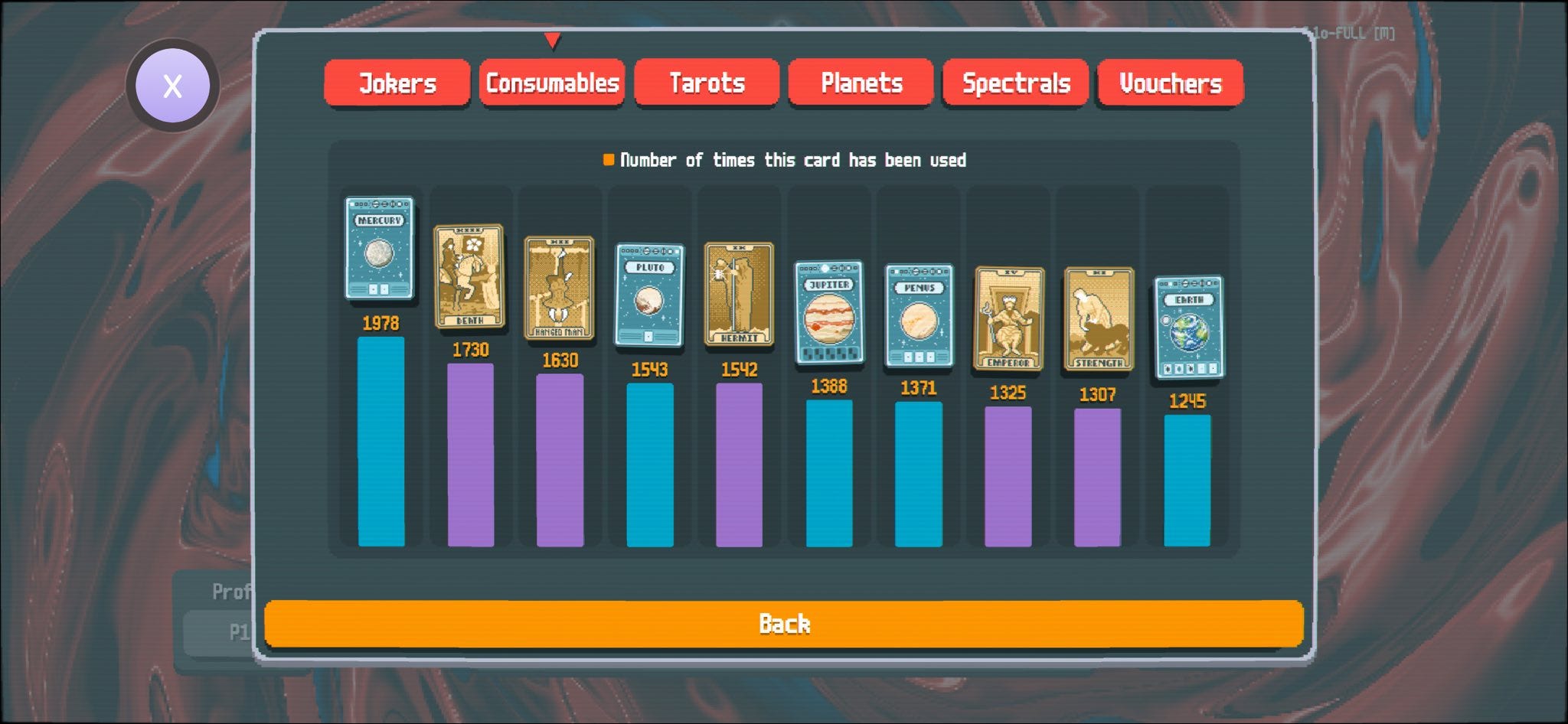
And now, finally, I’ve arrived at why I adore Balatro. Why I’ve spent hundreds and hundreds of hours playing it over the past 2 years. It is, quite simply, a silly little toy version of The Game of Life.
Balatro, like The Game of Life, requires three things to succeed:
That is — life is about changing yourself, changing what’s around you, or working with what you got.
And, like life, the requirement is to make the decision in the moment which makes sense. Should you change yourself and how you’re playing? Should you change the environment? Should you double-down on what you have?
Any of the answers may be perfectly valid. That’s part of the beauty. Sometimes there’s a right answer but, usually, there’s a couple different options that could work if you play it right. You just have to pick your path and find out.
Over and over and over again. Pick your path. Lose even with a good choice. Win even with a mistaken play. But keep playing. Keep learning and growing and deepening your knowledge so you can do better in the future.
But never forget that sometimes you’re going to lose even if you don’t see where you made a mistake.
Balatro
I lose Balatro quite a bit. At this point the community hasn’t found a single game that cannot be won if you have enough perfect knowledge of the state of the game beforehand but lacking that perfect knowledge, this game gets fucking hard.
Without delving into the mechanics, though, the game revolves around responding to a certain level of randomness with one of the three actions above. Change yourself, change your environment, or build on what you already have.
Sometimes I know what I should have done. Sometimes I feel like I did everything right. Frequently I had simply lost focus and I knew where the game turned, other times my creative ideas just didn’t pan out, and other times I played everything absolutely perfect and it makes my whole day to have pulled off a success at the difficulty level I play at.
Just a little toy version of life.
And I keep coming back. For years I’ve been coming back. Just to see if I can get a little better. If I can adapt instead of exploit what I have. Or I can tweak my style just a little bit. It’s 20 or 30 minutes when I’m exhausted. Or 5 minutes while I wait for something else.
At this point I have gotten very very good. I have ground out an accomplishment that only 1% of Balatro players has accomplished.
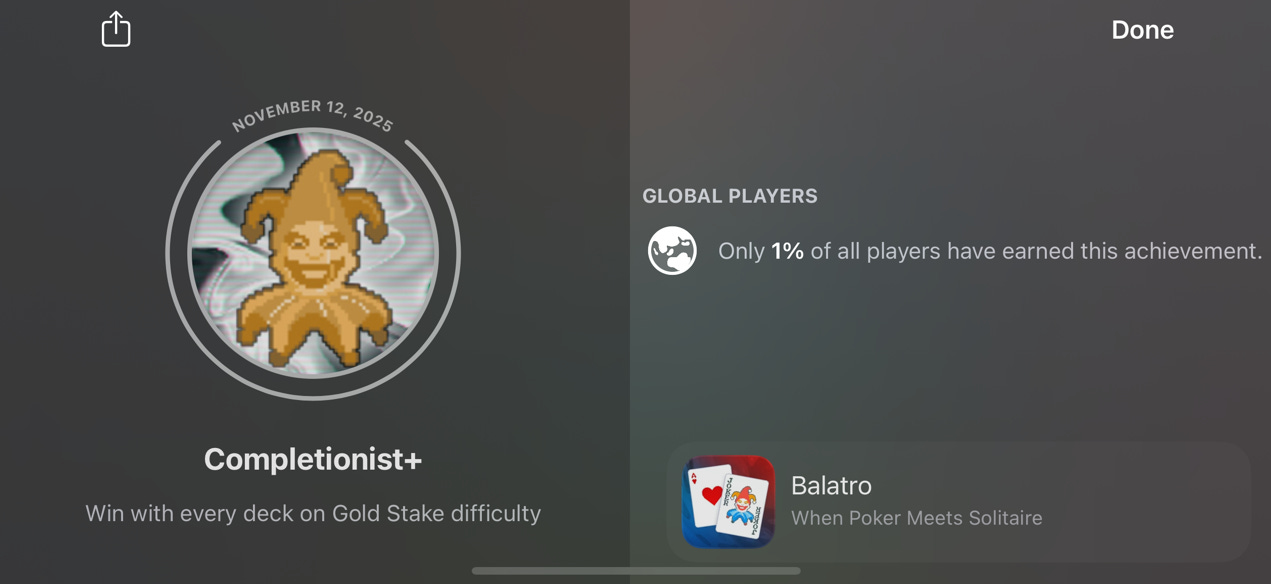
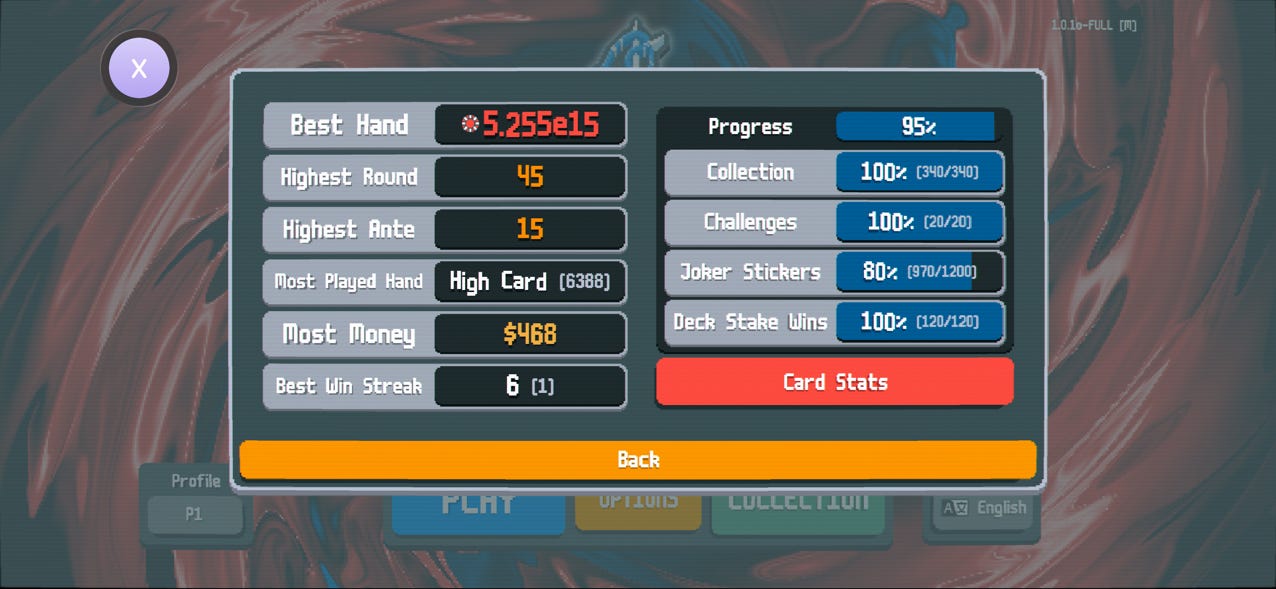
And I’m closing in on the final achievement. An achievement that doesn’t even have 1% of players accomplishing it. I just have to hit 100% on my joker stamps. After two years of playing I’m at 80% but I wasn’t really trying so…time will tell.
The Lowest Difficulty
Winning on “Gold Stake” difficulty is interesting. There are a pile of disadvantages that alter the game at that difficulty level. When I began playing I couldn’t conceive of winning on this difficulty. It took me weeks to win my first game on the lowest difficulty which, funnily enough, is the “White Stake.” More on that in a second…
But, slowly, I started seeing the complexities within the game. I made mistakes and more mistakes and then I made fewer mistakes. I started seeing the edges where I was most likely to win. About a year ago I just wanted to fuck around so I started a new profile just to see how well I did if I only played on White Stake. And I almost doubled my win streak.
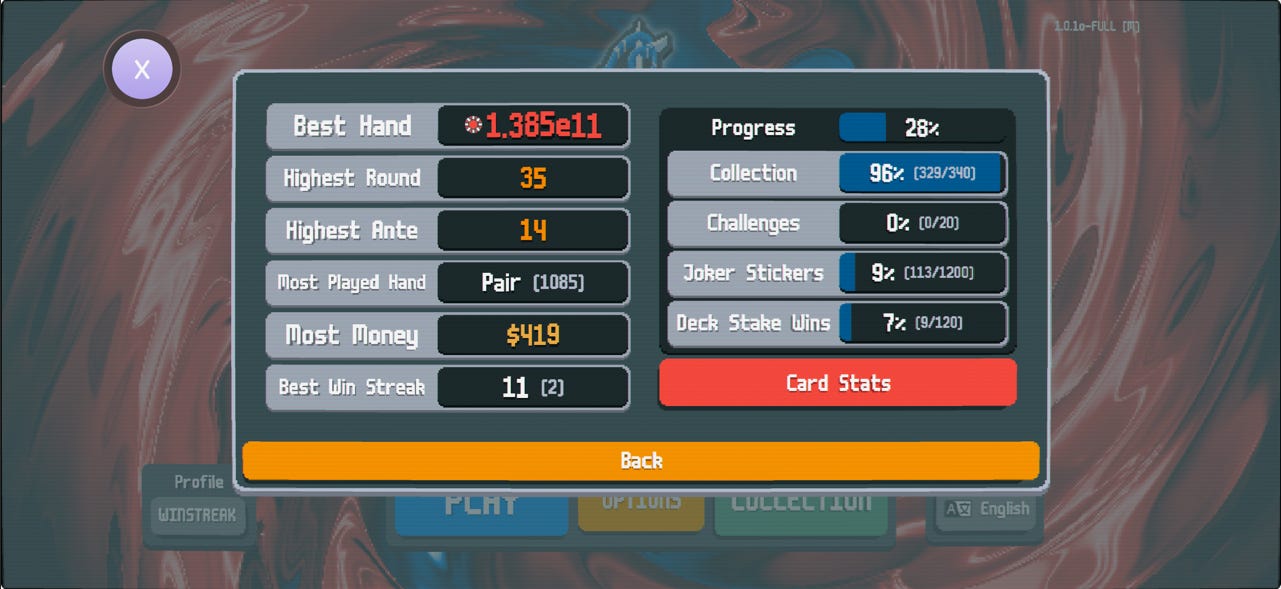
Because I knew how to play the game. But, also, because I hadn’t bumped my difficulty setting at all. I stayed in the kiddie pool just to have a simple mindless experience with barely any difficulty. Nowadays I switch between my “real” profile and my “winstreak” profile depending on my mood. Mostly I’m into getting that final achievement though.
But as I thought about all this I was reminded of yet another parallel to The Game of Life. The idea that we all start at different difficulty levels. And my favorite description of this, interestingly enough, also uses the lens of gaming. Years ago John Scalzi wrote about the advantages inherent in being a straight white male in America.
It’s titled The Lowest Difficult Setting There Is.
If you only click through one link, that’s the one you should click through. It encapsulates something in a way that anyone who has played many games can understand about the world we live in. The symmetry that appeals to me is that, even on the lowest difficulty setting, I still lose. No matter how well I play the game I can still lose Balatro at the lowest difficulty setting even though I have a very good understanding of all the mechanics. Even though I know exactly how to play the game.
Maybe I get a set of random circumstances. Maybe I lose focus and make a mistake that’s insurmountable. But it is so much easier to lose when I switch over to Gold Stake and play the game where it is entirely unforgiving and everything has to fall out right in addition to me playing near perfect games.
Coming Back
Whether I’m at the lowest difficulty setting or the highest difficulty I lose sometimes. Sometimes I should have changed myself rather than double down on the current setup. Other times I should have altered my environment. Occasionally Balatro is wildly unfair and I’ll get frustrated and walk away. But I always come back. I always want to play the game again. I can always get better, I can always accomplish one more thing.
All I have to do is play. Show up and give it another shot. Risk losing. Own my mistakes and learn from them. Stop learning and start dying, just like the Game of Life.
Squirt Says…
I know from experience that you play Balatro quite a bit. You definitely enjoy playing it. I notice it is mostly done with skill and not luck. This just goes to show that you like games without luck. Sadly, the game of life is a lot less skill and more luck.
Dad Responds…
While I think there is lots of luck involved I do think that the greater impact on the Game of Life is still the work we put in developing our skills…
(Something else he pointed out is that we have passed 8 billion people, and I was completely unaware of this. He didn’t want me to include this in his response but I thought it was great that he’s teaching me stuff because I was completely unaware that we hit that milestone a couple years ago. It’s great to have a kid that knows things I don’t and I’m proud of him).
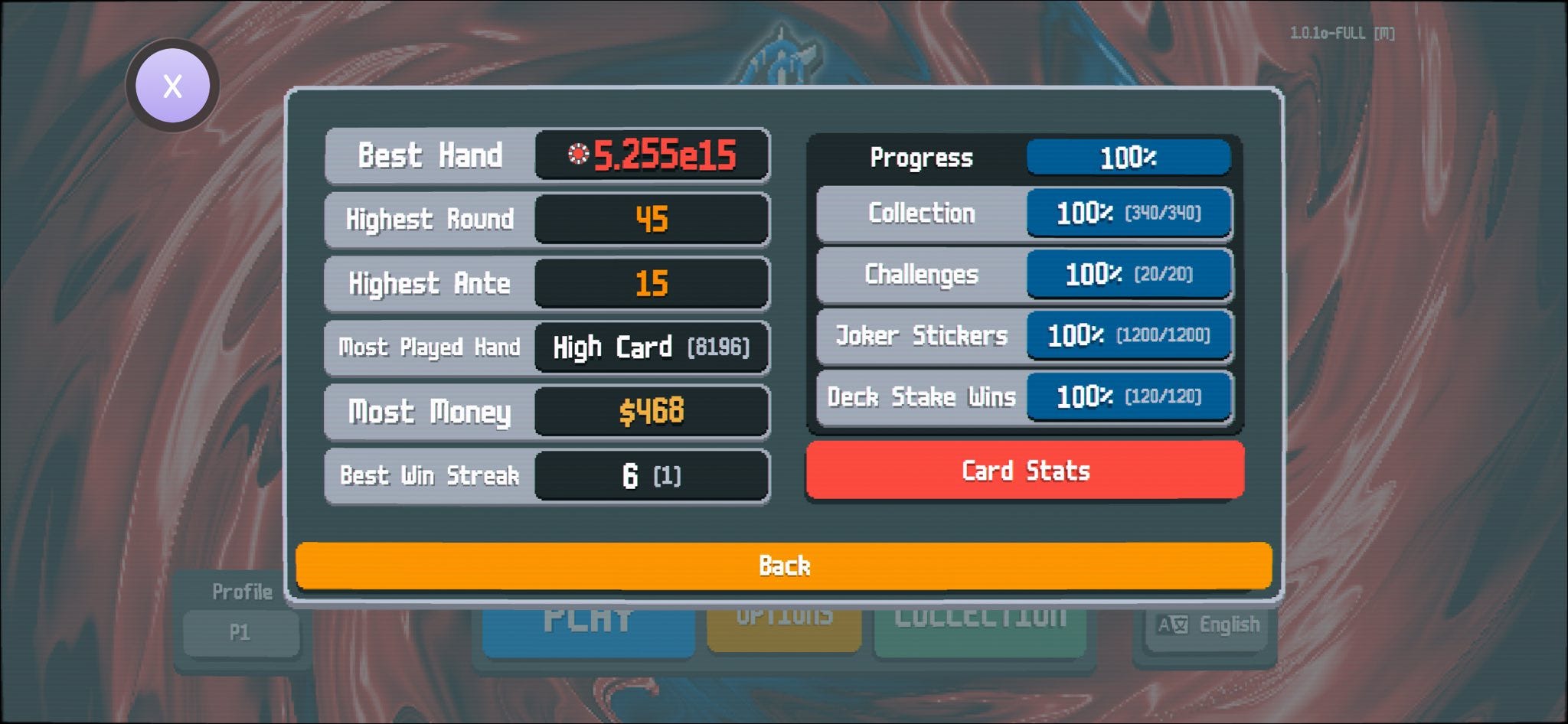
1.24.2026 Update
It is finished.




Loved Balatro. Also kudos for framing “stochastic” in a way that might finally enable me to permanently remember its definition. As for life, sufficient determinism argues it’s functionally deterministic for us, despite what we may believe :p
Life is difficult but we have to take it one day at a time. Enjoy each moment and learn from your mistakes. I love reading what you and Squirt write