


I started hearing about Abundance by Ezra Klein and Derek Thompson almost immediately after it was published so I didn’t pay super close attention to everyone’s opinions on it before I could it for myself. That said, I did pick up on the common thread of Republican intellectuals snidely laughing up their sleeves about a liberal discovering that regulation can be bad so I wasn’t going into it entirely cold…
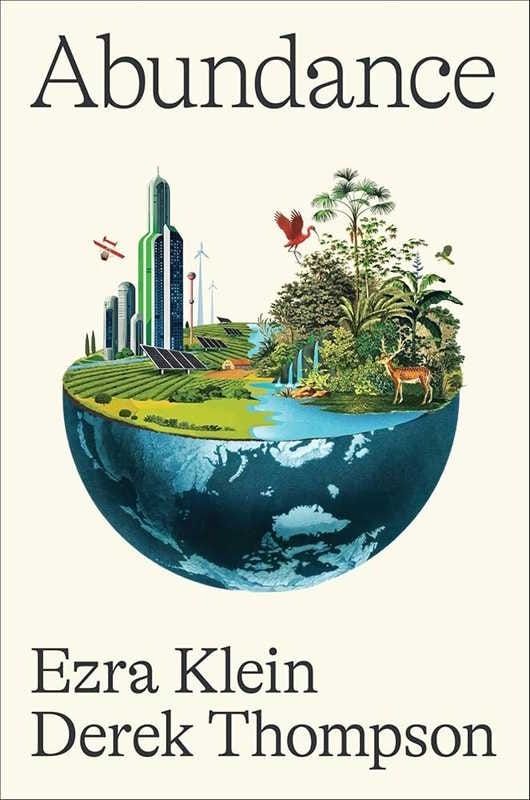
One of the first things that jumped out at me was the simplicity of how they laid out their agenda. The chapters are named simply:
Grow.
Build.
Govern.
Invent.
Deploy.
That appealed because, at its heart, that’s the direction I want to see America and the world go. And I do think humanity is poised to do exactly that and achieve abundance.
As a general rule, my favorite people to read opinions of are folks that are open to criticizing their own side because, personally, I don’t have a side. The Dispatch is unabashedly conservative. Klein and Thompson are unabashedly liberal. But both are closer to my personal definition of ambivalence when it comes to how America is governed. That is, they are willing to recognize that the other side is right sometimes and that their own side is wrong sometimes.
A big part of this book, the part that I bet is getting all the splashy headlines, is that this book is liberals talking about what liberals are getting wrong. I think that’s a powerful message to bring forth. But there’s also a tension there because while a conservative might like to read this book and pretend it’s arguing for things like deregulation it really is not. To read this book as an attack on regulation or big government is to misunderstand the motivations of the authors.
The motivation is to get us to abundance. Cheap or limitless energy. Food. Housing. Healthcare. Life expectancy. Entertainment.
More of everything.
And the motivation is to recognize that we could be doing way better than we actually are in getting there. This book is a condemnation of our politics and how we’re all fucking it all up. Liberals, conservatives, MAGA, voters, whatever. It’s a really shiny package explaining how everyone is so damn short-sighted that they’re entirely missing a forest for the trees.
I really think this book is just trying to make everyone recognize the screwups. And that’s kind of neat. I would love to see more of this type of reasonable futurism. They aren’t talking about flying cars but instead about things that feel very achievable in my lifetime. I found it highly encouraging, engaging to read, and gave me insights into a liberal mind that I am naturally disconnected from in many aspects. Now I’m interested to read other folks thoughts and see where it sends my own brain so…


First we have a fellow substacker that I’ve really been enjoying reading since I found them.

Noah goes into something that I really appreciated: the focus on the goal. My favorite quote from his piece is:
Abundance liberalism just doesn’t care about that stuff; zero-sum status struggles like that are simply not a goal. What matters to the abundance agenda is that regular people — the middle class, the working class, and the poor — have a less onerous life. If that means rich people have to give up some of their wealth, then fine, but if it means that rich people get richer, that’s also fine.
I don’t care how we solve this stuff, I’m not trying to win political points on with a party. I just want to make life better for “regular people” in the largest and quickest way possible. And that’s what I loved about the book.

Next up was the first edition of The Dispatch’s Energy newsletter. I was thrilled to see them start this particular topic as a weekly thing because, as I’ve written before, our endless hunger for energy is vitally important in this world today. While this newsletter was more about the need for permitting reform it is, I think, a great example of why I hope the Abundance movement grows.
This is ultimately why I’m optimistic about Abundance and permitting reform. While Washington rarely functions well, if there is enough constituent demand for change, it will typically happen. If both sides agree that “red tape” is indeed a problem, maybe we will finally see permitting reform progress.

Next was another substack by way of a paywalled G-File that introduced me to the Niskanen Center thinktank which I can already tell is going to a rabbithole for me.

My choice quote from this one is:
Niskanen’s conception of the politics of the abundance agenda differs from Klein and Thompson’s, but I believe the two approaches are entirely complementary. Klein and Thompson are a pair of progressives who are addressing fellow progressives and offering a new paradigm for center-left politics. At Niskanen, on the other hand, we try to transcend political and ideological divisions: we develop policies that can appeal to (at least some) progressives for progressive reasons and (at least some) conservatives for conservative reasons. It is inherently unpredictable when and from what source political demand for our supply of ideas might arise, so we don’t prejudge the issue: we happily peddle our wares to all comers.

Then I came to the real snark with Kevin D. Williamson (paywalled) where, really, he just wants to pretend he’s smarter than every liberal out there and every problem can only, obviously, be solved by “more freedom” and a recognition that the world will always suck for some number of people because scarcity is a thing. Honestly probably the silliest take and a good example of why I can only read some of his stuff if he’s attacking the people I want to see attacked. No quote for Mr. Williamson.
And I found a handful of interesting Goodreads reviews as well that I won’t quote but this one is my favorite.
Finally I close with a quote from the book. Overall I found this book well worth my time and I’m gratified that it’s been getting so much ink spilled over it. These are the thoughts we need to have to get a better future. Bravo.
This book is dedicated to a simple idea: to have the future we want, we need to build and invent more of what we need. That’s it. That’s the thesis.