


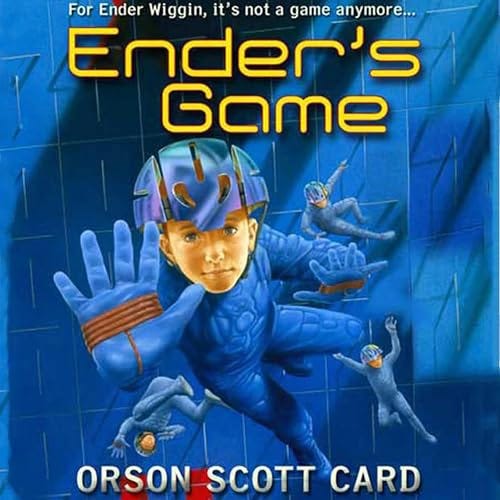
(Editor’s Note: This is more truly a book meditation. It has spoilers. If you are heavily spoiler averse…go somewhere else).
I bribed Squirt with some vinyl records to get him to read Ender’s Game and, you know what, I’m not even sorry. I would be hard-pressed to find a book that has informed my life and worldview more than this book. I wish I could cram it into everyone’s head. I read it for a tenth time after Squirt did just so I could refresh myself.
Connection
According to Wikipedia, Empathy is generally described as the ability to perceive another person’s perspective, to understand, feel, and possibly share and respond to their experience. It is, in my opinion, one of the most vital foundations to the human experience. The absence of empathy is also a primary characteristic of Antisocial Personality Disorder according to the National Institutions of Health. That is to say…sociopaths and psychopaths generally disdain empathy. In autism research the difficulty to connect, known as the double empathy problem, is something studied as well. The Theory of Mind is, essentially, a theory about empathy as well. It’s a favorite subject of mine because I see humanity as a gestalt that forms a system.
…that’s lots of links but I needed to get that out of the way first I think.
Empathy is about connection and understanding. It’s about a form of communication that exists at a level underneath everything else. When you “read between the lines” you’re forming an empathic connection with the author. When you really “hear” what someone isn’t saying that’s empathy.
I think it’s impossible to really understand somebody, what they want, what they believe, and not love them the way they love themselves.
~ Orson Scott Card, Ender’s Game
I’ll probably pepper some more quotes from the book in here but that one — that’s what makes Ender’s Game unique. There are many books out there about connecting with others but I’ve never found another that weaves it throughout the entire narrative of children learning to defend humanity.
Children
I’ve purchased this book more than ten times in my lifetime. I buy it every time I see another used copy because I never want to be without one to give to a kid. Especially a precocious kid. I was a precocious kid and a teacher handed me this and it changed my life. Here was a book about kids that didn’t dumb things down. That talked to me like a full human being. It wasn’t massaged and manipulated and softened for a child’s ears. These were kids that were going to shake the universe and, dammit, maybe I could as well.
This, I think, is something I’ve brought forward into being a parent. I generally talk to Squirt like he’s fully capable of understanding any concept out there in the world. He may lack context or experience, but his mind works fine, better than many adults honestly. I treat other kids the same for the same reason. My parenting and “adulting” styles are to assume that the adolescent may need some more explanations but they’ll grasp the ideas perfectly fine afterwards.
Meeting my Dad
When I was twelve years old I flew up to New Jersey to visit my biological father, who I hadn’t seen in almost a decade. That week with a man I barely knew 700 miles from my parents had to be terrifying for literally everyone involved. My parents had to watch me fly away. This stranger who hadn’t really been a dad since I was two years old suddenly had a human in his care. And me, who just knew this guy as someone who I talked to on the phone occasionally and always sent me a birthday present. Terror. I guarantee nobody was comfortable with this happening but it was the right thing to do.
On the drive back from the airport my dad smoked and we barely talked. How do you connect with a stranger? But when I walked in the door of this house there was a bookshelf. And on one of those shelves was Ender’s Game. Here in this strange home on a different side of the country in this city that just did not smell right was the same edition of a book that was sitting back on a shelf in my old classroom. My teacher had lent it to me just last month. Suddenly we had something we shared.
Dad and I sat in his living room and talked about the ending and how it surprised us, then we talked about other books on his shelf. I felt some of my terror just evaporate while we sat there in his living room and connected over our shared love of reading. Looking back, I think that was when some of my dad’s fear started to melt away as well. For the next two decades, my dad and I could always talk about books. We traded them back and forth, we critiqued them, and we loved them. And whether I was twelve or twenty-two or thirty-two always he talked to me like another human. He talked to me like I was a brilliant kid in a space station learning how to save the world.
Because never in my entire childhood did I feel like a child. I felt like a person all along―the same person that I am today.
~ Orson Scott Card, Ender’s Game
Connection Again
One of the other things that has stuck with me is how that connection can be misused. The classic double-edged sword on display throughout the entire book. Peter, capable of empathy as much as Ender but obsessed with control. Valentine, just as capable of empathy, but lacking the ability to use it for what is needed: the destruction of an alien civilization. And then, of course, there’s Ender:
In the moment when I truly understand my enemy, understand him well enough to defeat him, then in that very moment I also love him. I think it’s impossible to really understand somebody, what they want, what they believe, and not love them the way they love themselves. And then, in that very moment when I love them.... I destroy them.
~ Orson Scott Card, Ender’s Game
I see this frequently reflected in politics, which of course is exactly where Peter ends up. The ability to empathize allows for things like populism to thrive. Maybe you achieve world peace, maybe you tear down centuries-old institutions. Both are on the table. And in the end I think that’s the most philosophical detail for Ender’s Game: when is it okay to use your empathy to win at all costs?
Games
Remember, the enemy’s gate is down.
~ Orson Scott Card, Ender’s Game
A game has a goal, and rules, and systems. So, too, does life. And as with life and a game you have to ask the question, what is the goal? Everyone has to answer that for themselves but the distractions are always there. And the unfairness. The world isn’t fair, so of course Ender’s training isn’t fair either. He’s isolated and outnumbered and the enemy cheats. I think his greatest teacher says it best:
“An enemy, Ender Wiggin,” whispered the old man. “I am your enemy, the first one you’ve ever had who was smarter than you. There is no teacher but the enemy. No one but the enemy will tell you what the enemy is going to do. No one but the enemy will ever teach you how to destroy and conquer. Only the enemy shows you where you are weak. Only the enemy tells you where he is strong. And the rules of the game are what you can do to him and what you can stop him from doing to you. I am your enemy from now on. From now on I am your teacher.”
~ Orson Scott Card, Ender’s Game
Even here what the old man is talking about is empathy.
The End
Connection can be used to build or to destroy. The climax of the book highlights both. Ender’s team only works because he empathizes with them. He understands their strengths and weaknesses, he knows what they are best at. And he turns that understanding into a brilliant battle strategy that allows him to win that final game. But, at the same time, he uses the understanding of the enemies themselves. He finds where they are weak, he knows where they are weak. And in the end he earns a new title: Xenocide.
And in the ultimate finale of the book we see yet again that the entire war was a misunderstanding. A missed connection. A lack of empathy.
So the whole war is because we can’t talk to each other.
~ Orson Scott Card, Ender’s Game
So Ender, the only one who can actually empathize with the civilization that he wiped from existence, writes a book to explain. He becomes a Speaker for Dead. Someone who doesn’t shy away from the lived mistakes of a life but embraces the mistakes and the triumphs both.

I believe that one of the most valuable rewards of reading heavily is to grow your empathy. You are literally reading someone else’s mind, someone else’s imagination, someone else’s insights. You cannot help but expand your perspective by doing this. This carries with it a value that cannot be tallied. And I credit the fact I recognize value in empathy and connection because of Ender’s Game - the story of a little boy who connects with those around him and, you know, does some other stuff too.
Squirt Says…
Empathy is everything. Empathy is what drives us. It’s what allows us to be us. Without it we aren’t us. We are mindless uncaring soulless animals. We don’t do anything for anyone else without empathy.