


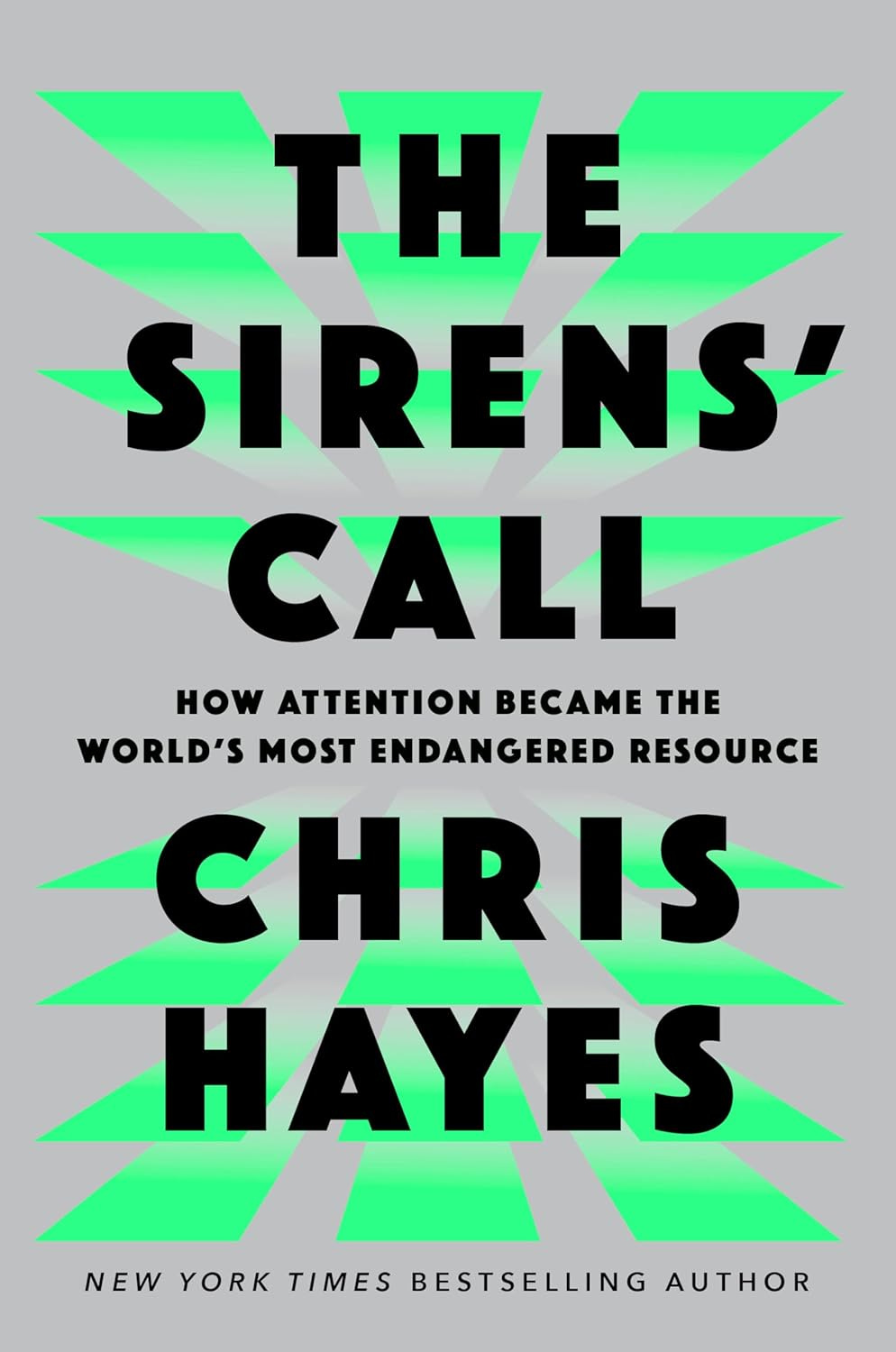
I adored this book but I’ve been struggling with how to really review it. I have a couple false starts of blog posts related to concepts within its pages because I’ve been thinking specifically about the “attention economy” for the last month or two very heavily.
Let’s start with a brief review of the mechanics:
One of my favorite things about Hayes’ approach to this book was his awareness. And what I mean by that is that his existence depends on commanding attention and he personally thrives on attention. These incentives, and this personality, is the primary reason I do not watch television news and the news I do get comes from a pretty curated set of written sources. (Quick plug for The Dispatch which I read every morning).
So to have someone whose livelihood is tied up in the attention economy taking an incredibly thoughtful and nuanced look at one of the the largest problems in our society was fantastic. He’s a gifted writer with a voice that falls very well into my head. The research was top-notch and pulled together to support his assertions and thought provocation. I would highly recommend this book and it had me at five stars from the outset and never let me go.
My personal metric for a non-fiction book is how much dog-earing did I do. So…
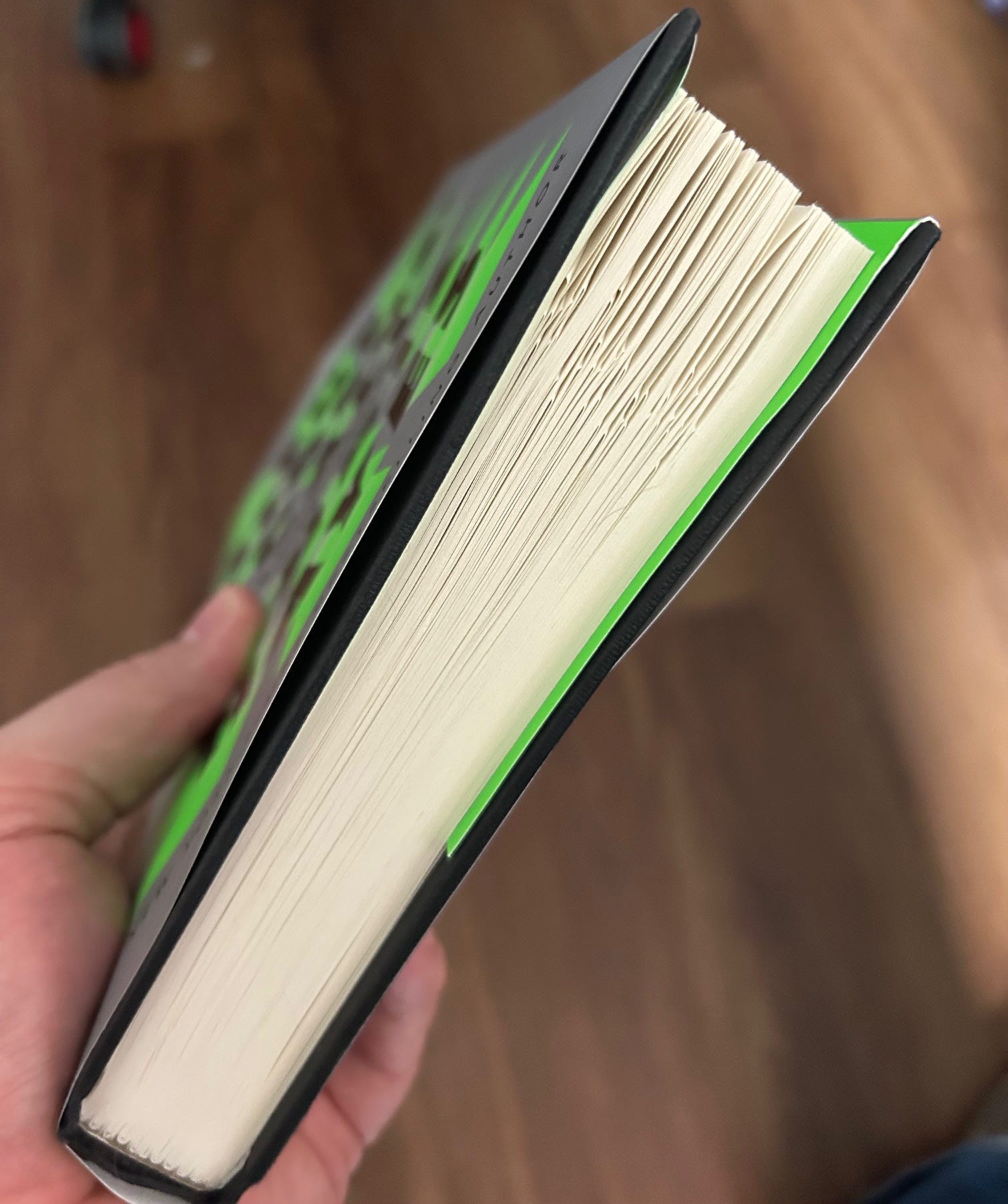
I fully expect to reference this book frequently in the future because it was that good. But for today, having just finished it, I’ve already got some things to say.

Every day is a question: What will you focus on? What will you give your attention to?
The central thesis of Sirens, which I agree with, is that this is a Zero-sum game question. For every moment of attention you give to one thing it’s less attention you have to give to something else. And your attention is valuable. Valuable to you as a human being but also valuable to whatever, or whoever, you give that attention to. You spend it. It is, literally, a finite resource no different than money or food or electricity.
And like any other resource you spend the expectation is that you should get something for it. You give up your attention and in return you are entertained or educated or informed. While we all intuitively understand this - who among us hasn’t gotten frustrated at someone wasting our time and attention - I had never actually framed the way I live my life through this lens.
As I read this book I viewed my life through that very lens, much like Hayes does in his narrative, to consider what the modern world is doing to me. To us. I obviously found it pretty horrific but I also found it giving me a new framework for why I make many of the decisions I make.
I mentioned earlier that I don’t watch the news. The primary reason I do not is because the primary motivation of the news is not to inform me but, instead to monetize my attention. If it bleeds, it leads [and makes the news money].
I keep my phone on silent and frequently not in my pocket because I don’t like being interrupted. I angrily disable push notifications for the same reason and keep messenger apps off my phone. I deleted Twitter even though I was addicted to it because I didn’t want to be monetized. I close Facebook five seconds after opening it because they’ve fully embraced Enshittifcation and I can’t see a damn thing of my family and friends. I refuse to use TikTok with any regularity along with Instagram/Reels/whatever-the-fuck.
This all feels…virtue-signal-adjacent to mention but it’s important to me not to praise myself, but because each of these things is one more consumer of my valuable attention. All I really knew was that if I did all of these things then I would look at the clock at the end of the day and be like “what the fuck did I do today?”
I choose other things. Playing games, talking to Squirt, walks, reading books, or reading online. But, of course, there’s trade-offs. Someone left me a message hours and hours ago and I didn’t see it. I am woefully disconnected from breaking news and the zeitgeist of politics now. I have no fucking clue what’s going on with my friends and family.
More connected than twenty years ago, you just have to let all your attention trickle through your fingers to get the dregs and give the rest to whichever platforms are your drug of choice.

I especially like how Hayes’ frames the societal shift of this attention economy. He and I are contemporaries and that meant I followed all the cultural shifts that he referenced. I can see how things have gotten so much worse and it freaks me out and scares me when I think about Squirt. We aren’t wired for operating in this environment. Harari had similar thought processes in Nexus where he talks about the alien nature of the algorithm.
When you only optimize for monetization scary shit happens. When humans and their attention become a commodity scary shit happens. When humans accept their attention being commodified scary shit happens. Yeah, I’m looking at you America in 2024 where you decided to elect Trump again because he is a savant at commanding attention.
This, too, was touched on in the book. Along with the idea of there not really being a “defense” to this type of attention-mongering. I particularly appreciated his historical call backs to the Lincoln-Douglas debates which made me feel inadequate all the way down to my toes as a signal for just how far we have fallen.

The final portion of the book, where he delves into seeing how the future might go and how we might combat some of this, is where I did find myself the most in conflict with Hayes. Suffice to say his liberal tendencies stepped into the spotlight. But I’m not sure what the answer is either. The first, and most obvious, is that I would encourage virtually everyone to read this book. I’ve already been reading passages to Spouse and Squirt both. Awareness of a problem is a requirement for solving the problem.
But I do not necessarily see how to bring that awareness to the world at large. It’s easy, enticing, and and distracting to play the slot machines that platforms put in front of us. We all fall into the traps. But at least we can take a step back and start seeing the traps and Hayes’ book lets every reader get some much needed vision correction.