It’s been about 36 hours since I finished Robert Pirsig’s book and I find myself struggling mightily with what to say about it. But as is my custom I don’t want to read reviews or thoughts on the book until after I write my own review so I’ll just take the plunge here.
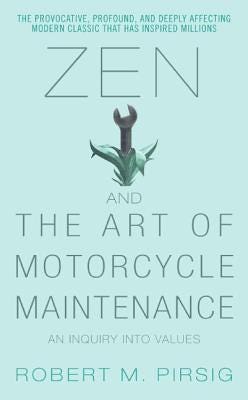
This book has been on my shelf for over twenty years waiting for me to read it, and the only real expectations I had established were that people I respected in college recommended it. And that it has Zen and motorcycles in it.
I don’t really think I can “review” this book without “spoiling” some things in it. Though there really isn’t a whole lot to spoil. I’m also not sure how meaningful this review will be for anyone who hasn’t read it. However, just like the book, I think there are a number of threads here and some of them really don’t have much to do with this book specifically, so with that fuzzy-ass introduction…
I found this book a struggle to read. In fact, I think I broke it up into three different “sessions” with (many) other books in between them and it was right around 5 months from start to finish. I didn’t like the writing that much. I found the viewpoint character (and the author himself) pretty irksome and insufferable. I did enjoy many of the ideas, but even those dragged a bit so when I’d get to the end of a chapter or the end of a part I would walk away for a bit.
I’m not sure I really lost anything by experiencing it this way. There is no true narrative. Instead there are three threads throughout the book. First is the foreground of a man on a motorcycle driving across the country with his eleven-year-old-son. Second is the background memories of how that man ended up on that motorcycle. Finally, there is the “inquiry” part of the “inquiry into values” portion of the book — a meditation on quality, philosophy, and trying to find that One Answer For Everything.
So why even continue? Because despite all the unenjoyable aspects of the book it was putting new ideas in my head and reframing old ideas that were already in my head. I found the journey into Quality fascinating. I thought the 1970s framing, a time period of major disruptions, very timely here in 2026. “Groovy” and “square” fit just as well 50 years later. The synthesis of Western and Eastern philosophy was something pretty unique to me. I marked page after page of “interesting” passages throughout the book.
It was the equivalent of getting some interesting and novel ideas presented to me while slowly realizing that I really didn’t like this guy. And it’s important to point out here that I didn’t like the narrator nor did I like the past ego of Phaedrus, though for very different reasons. I found the narrator to be a coward. I found Phaedrus to be smug. Though in some ways maybe it was for the same reason — I found both of them to be inveterate narcissists, wholly involved only with themselves and their own headspace.
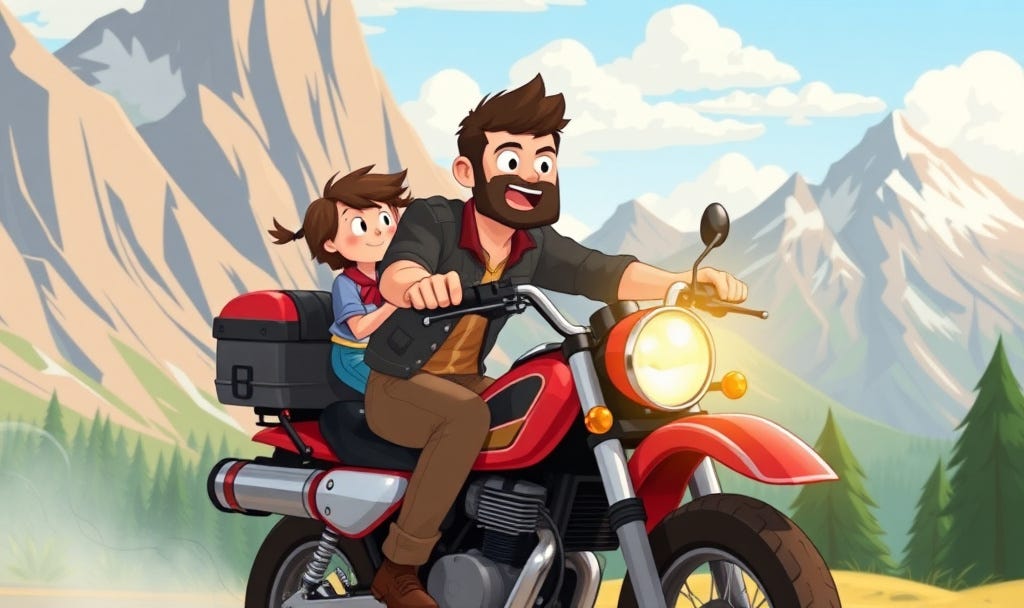
This is, perhaps, most apparent when viewed through the lens of the narrator’s son Chris riding on the back of the motorcycle. The boy who doesn’t see anything but his father’s back while they drive through the country. The boy who hasn’t really been taught to communicate because it doesn’t appear he’s been communicated with very much. Ostensibly the whole journey is supposed to be about Chris and yet looking back over the narrative…it really was not. Chris is as much a ghost in the narrative as Phaedrus — though Chris is mentioned less and possesses even less agency.
Perhaps this says more about me than about the book. I have very strong expectations of fatherhood and I felt like they were not met at all. And I struggle with overt philosophy much of the time because I find it reductive and frequently masturbatory. So to read about someone trying to “make it make sense” to the point of an obsession that disregards their son I’m not sure I can help but feel like it’s incredibly self-involved.
Insightful though, too, and thus my ambivalence. Some journeys are not meant to be easy or comfortable or to be taken just with people that you love. Sometimes you just have to drive down the bumpy road and listen to the sound of the engine I suppose.
So I think it’s a good book. I think it’s a thought-provoking book. I think wading into the mind of the author will give me insights into how to live my own life and how to think about the world. I guess I’m glad there are people in the world thinking and writing like this, but I don’t think I would be at all interested in sitting down and getting to know the author at a bar or on a motorcycle trip.
Which, of course, now raises the question — was that the point? Was this supposed to be a raw human with all the niceties stripped away and anyone like that is unlikeable? Was writing this book actually brave? Was there just more subtext I was supposed to pick up on that solved for the fatherhood gaps and the narcissism gaps? Maybe I just don’t “get” it. This is a frequent thing for me when I read the “classic” and “popular” books, that I suspect I’m just missing something.
In the end, it doesn’t matter. What does matter is that it was worth reading and it has Quality.