Squirt and I have been talking about how I consider myself psychic and I think he’s one too.
The reason I consider myself, and him, and you Dear Reader, psychic is because of our ability to read things that have others have written. As I explained it to him, every time I pick up a book I am reading the mind of another person. Their ideas, their stories, and their imagination. It is, in my opinion, one of the most powerful aspects of being human - the ability to communicate our minds out to someone else. And I followed that up with the fact that it has the benefit of making us smarter because it allows us to be exposed to things we would have never encountered on our own.
I’m reminded of this as I read this article where the author has this idea that boils down to something like “I have all these limitations, and that makes me better than AI.”
To wit:
“Considering limitlessness [of generative AI] has led me to believe that the impediments of human writers are what lead us to create meaningful art. And they are various: limits of our body, limits of our perspectives, limits of our skills. But the constraints of an artist’s process are, in the language of software, a feature, not a bug.”
They go on to state:
“Compared with AI, we might seem like pitiful creatures. Our lives will end; our memory is faulty; we can’t absorb 191,000 books; our frames of reference are circumscribed. One day, I will die. I foreclose on certain opportunities by pursuing others. Typing this now means I cannot fold my laundry or have lunch with a friend. Yet I believe writing is worth doing, and this sacrifice of time makes it consequential. When we write, we are picking and choosing-consciously or otherwise-what is most substantial to us. Behind human writing is a human being calling for attention and saying, Here is what is important to me. I’m able to move through only my one life, from my narrow point of view; this outlook creates and yet constrains my work. Good writing is born of mortality: the limits of our body and perspectives-the limits of our very lives.”
It’s a truly interesting framing. I’ve went from thinking that she is a silly Luddite holding back the the tide, terrified of being made redundant, to thinking that she has made one of the more insightful points I’ve read about AI. And then maybe back to “yeah, no, this is stupid.” That’s the best kind of thing for me to read - something that I find myself confused and ambivalent about. Because, for me, I think there are two different goals in reading.
My first goal of reading is some form of connection. To read another’s mind. She finishes her piece by saying:
“Novels are one of the best means we have for really seeing one another, because behind each effort is a mortal person, expressing and transmuting their realities to the best of their ability. Reading and writing are vital means by which we bridge our separate consciousnesses.”
And I think she’s very much right. Writing is, at its heart, A bridge between the creator and the consumer. I write, you read, you roll your eyes, and remind yourself yet again that you can skip my silly preaching.
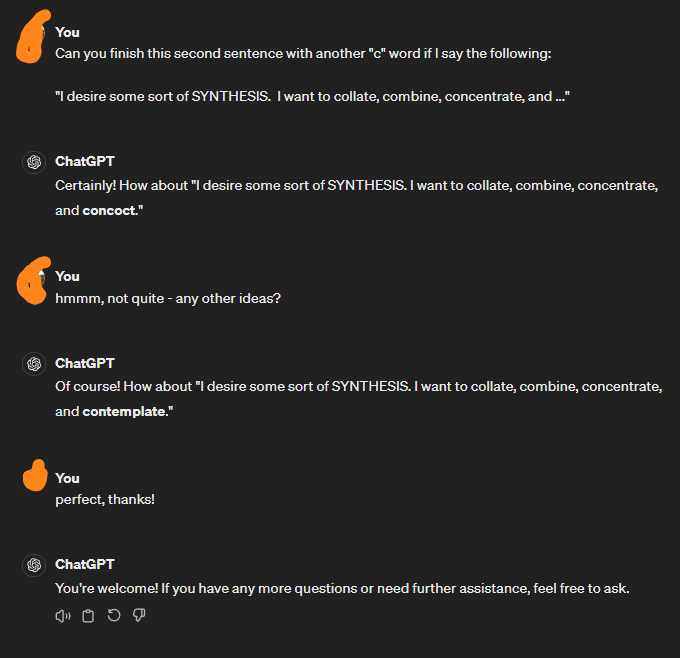
But I have a second goal when I read something. I desire some sort of synthesis. I want to collate, combine, concentrate, and contemplate another’s thoughts.
Fun fact, here’s how I arrived at that last word:
In the end I’m reading to expand my own horizons. I’m reading a book to change myself. It’s an internal exercise that means the person who goes to sleep tonight is different, and is more, than the person who woke up this morning.
Stop learning, start dying.
And this, I think, is where the ambivalence comes from. My first goal - to create a bridge between myself and another human - is really only achievable with a human. Someone who shares my limitations. But my second goal - to synthetize something external and integrate it and grow my own mind - is something I achieve all the time using the broad sea of human writing that’s been digested by generative AI and regurgitated by something that has very different limits than a human.
What is creativity? Is there something ineffable about thoughts from a human rather than “thoughts” from a grown intelligence that learned everything from us humans?
Squirt Says…
I’ve thought about it a little bit, and I realized that we are multiple intelligences. We have different parts of our brain responsible for different things. Which is similar to stacking AI - you have them spread out the workload. For instance, if you were creating a tennis AI you wouldn’t want to make it all in one that would take Quintillions of years to fill (Yes that’s a real number, look it up). You stack AI to make one to move a floating hand to position and another to keep that hand in a certain position quickly. So as I see it we are AI basically we just can’t think that fast or paint that fast or write that fast. AI is just us with unlimited time unlimited resources. [AI has] Infinite colors we are them just much slower.
Dad Responds…
(First, I need to teach Squirt how to use commas and periods more so there was some light editing of this one for readability.)
Squirt has been doing Scratch programming for a number of years now and what he’s leaning into, I think, is that programs work by having multiple functions with single responsibilities along with the concept of asynchronous multithreading. That’s a really interesting observation. And it fits with how LLMs work in some ways from my neophyte understanding of the hidden layers in the neural network.
The idea that AI is just us but…better is really what all of this conversation is about. I think the nuance of what makes us different is something we will continue to have to seek. It used to be that we could learn and build models the programs couldn’t but now? A fascinating thing to roll around in one’s head.