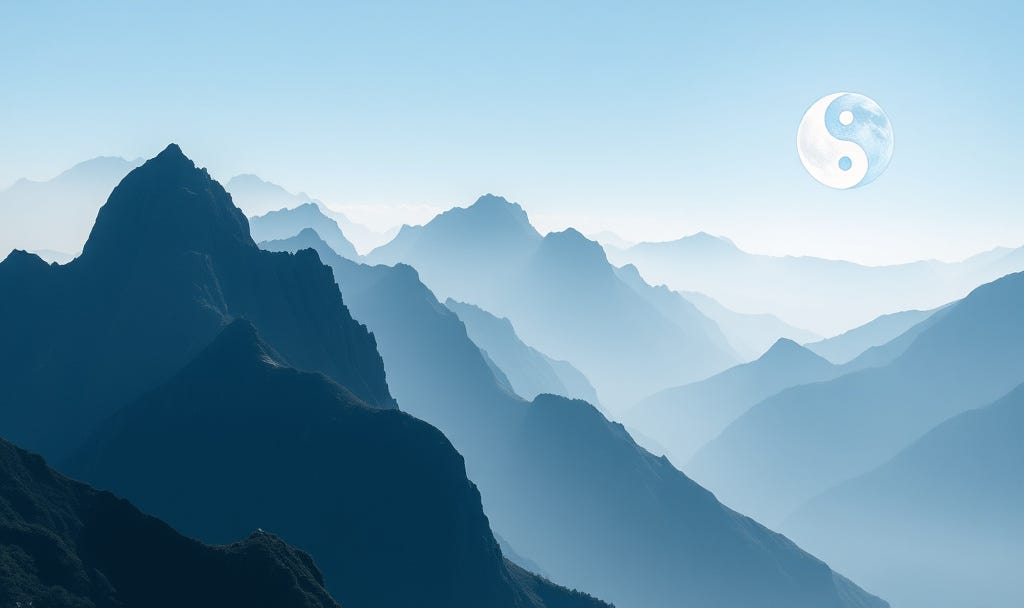
The Thread
Recently, Squirt and I have been talking about Heraclitus’ Unity of Opposites because what kid doesn’t want to talk with their dad about a Greek philosopher who predated Socrates? I never mentioned Heraclitus though. Instead I talked about a concept that I’ve found fascinating throughout my life: the idea that suffering and shitty things are the only way to define the good. Something I call “peaks and valleys” to capture a specific sentiment: duality drives definition.
Disease makes health pleasant and good, hunger satiety, weariness rest.
~ Heraclitus
We have also been talking about poetry recently. Squirt, just like me at his age, has struggled with it. His complaints are the same complaints I had for the first couple decades of my life — namely that poetry rarely makes sense. I’ve lived my life trying to live as the astronaut instead of the caveman and Squirt naturally ends up there much of the time as well. But buried in that piece is a reminder: you need the caveman too.
Poetry, perhaps more than anything else, embraces that caveman side. It’s about touching on the ineffable that cannot be put into words. It’s not about going to the stars so much as looking at the stars and feeling.
The Guest House
This being human is a guest house.
Every morning a new arrival.
A joy, a depression, a meanness,
some momentary awareness comes
As an unexpected visitor.
Welcome and entertain them all!
Even if they’re a crowd of sorrows,
who violently sweep your house
empty of its furniture,
still treat each guest honorably.
He may be clearing you out
for some new delight.
The dark thought, the shame, the malice,
meet them at the door laughing,
and invite them in.
Be grateful for whoever comes,
because each has been sent
as a guide from beyond.
~ Mewlana Jalaluddin Rumi (translated by Coleman Barks)
You can click the title of that poem if you want to read some pretty good analysis on it, but the beauty of Rumi’s Guest House is that everyone connects to it in a different way and, indeed, I find quite different connections to it now than I did twenty-five years ago when I first discovered it.
Philosophy, poetry, and then I have the sixth novel from one of my favorite science fiction series of all time.
“Life is meant to be felt. Else why live? Valleys make the mountains.”
~ Pierce Brown, Dark Age
I like most quotes to stand alone but this particular one can benefit from a little context. The words are spoken by Sefi the Quiet — a warrior queen of a slave race bred for war by her masters. She’s talking to a “civilized” man who has given up on living and buried himself in drugs to numb his pain. Soon after this quote they find themselves in deep valleys. The entire book is really a valley, thus the name, and easily one of the gloomiest books I’ve ever read.
But without the darkness how can you even understand what light is?
Recognition
I’m ambivalent about where to go from here. I first wrote the phrase “depression lies” — turns out that’s such a trope of mental health that I literally cannot find a source for it. It is central to the concepts of Cognitive Behavioral Therapy but I wasn’t really looking to talk about that. Heraclitus wasn’t thinking about depression, nor was Rumi. And yet I think it’s a vital part of the peaks and valleys metaphor when we talk about the darkness and the depths. When you are deep in a valley the peaks look insurmountable. You cannot imagine ever getting to the top. All you see is the climb and the barriers and the darkness whispers, “you’ll never get there, why even try?”
My second thought was one of acceptance. Or perhaps “recognition” might be a better word. Recognition that, yes, the valleys fucking suck. That they do exist. That the climb will be hard and the barriers will be tough. It is true that depression lies, but there is truth in the whispers while you’re at the bottom. The lie isn’t that you’re in the valley and the peak is a climb. The lie is that you’ll always be in the valley.
Duality
If we subscribe to the Unity of Opposites then we believe that both sides must exist and define the other. And if we listen to Rumi there is a belief that each comes in sequence with another guest, a change, waiting just outside the door. And finally, if we listen to Sefi, we embrace that life is about feeling all of it. The peaks and the valleys both. And always wary of the lie that there will not be a change. Whether that’s believing you’ll always be at the peak or always in the valley. Wherever you find yourself if you keep moving forward and growing you’ll find yourself on the opposite side down the road.
And finally, I think it’s important to recognize that the opposite always exists. Laughing at a funeral. Anxiety because you realize something amazing can be lost in an instant. I was looking at a photo Substack this morning entitled Holding the Opposite which delved into this from the perspective of the Yin and Yang. The idea that both exist and define each other but also that there is always an aspect of the other inside as well.
The Point
There really isn’t one beyond recognizing a piece of reality. That’s it. Live with it. There are peaks. There are valleys. On a given day I can wake up in a valley or I can wake up inexplicably on a peak. At other times life itself has shoved us into a valley or given us a hand up. The important part is to accept what comes as a guest, realize that we can keep moving forward, and know that whatever may have come it can be faced with confidence.
Squirt Says
I don't feel that you need a valley to experience the peak. What person would torture others just so they better appreciate other aspects of life. A monster. The idea has come from the inevitability of it. It isn't possible to have a day without a valley. We have come to accept the inevitability of valleys and say that it defines the happiness. This is pure blasphemy.
Dad Responds
Hmm. We’ll need to revisit this down the road. Also we’re going to to have a talk about what the definition of “blasphemy” now.