I’ve been thinking quite a bit about creativity, and specifically creativity in the age of AI. I’ve also been collecting different writing where I muddle over AI Slop. Somewhere in my brain I thought I could turn all of this into a single cohesive point but, fuck it, that’s not going to happen. I’m giving up.
So here’s different chunks of writing written at different times and then some thoughts at the end. It’s my Substack, I can do what I want, dammit.
Substack / Pangram Partnership
Substack just partnered with Pangram to “identify AI text”. I saw it when I went to publish:
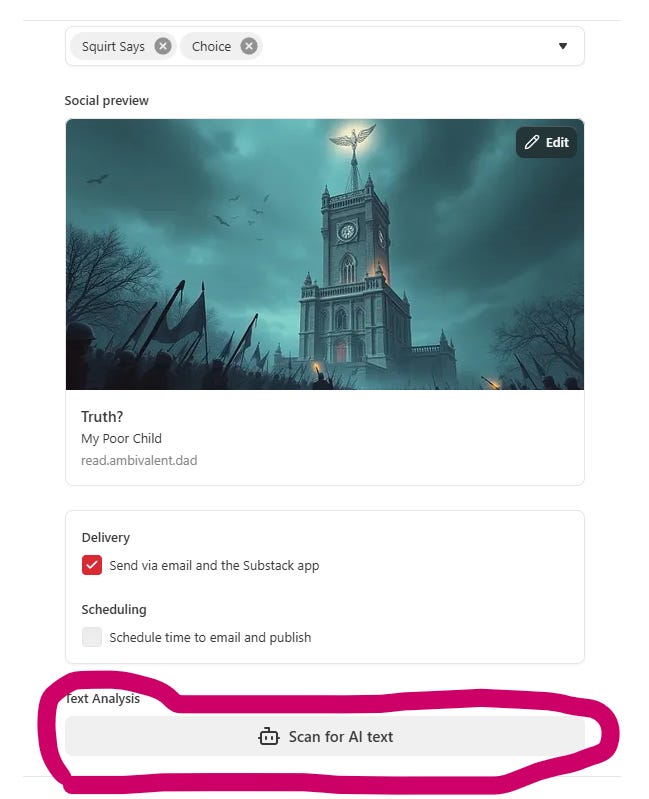
Dear Reader, you’ll be relieved, I’m sure, to learn that I passed my test and it was 100% “written by a human.”
Which is funny, because that’s a fucking lie, but whatever - it makes for good theatre, right?
As part of this new theatre I’ve written my own personal AI Use policy in Substack that is linked to anyone checking to find out if I’m writing “slop.”
The funny thing is, if you ask the game development community, the fact that I even have an “AI Use” to talk about means that all of my writing is total garbage. Even if all I did was have it check my grammar.
Big Walk used AI to fix a bug. Now the indie gaming world is having a reckoning.
I disagree pretty strongly with that bullshit witch hunt. It reeks. But this is very much the world of game development in November of 2026.
Humans Do the Slop
So Squirt and I were discussing creativity recently and how I see programming/technology as a highly creative profession. Many folks will focus on the “logic” of it or the “facts and data” but, for me, those are simply the building blocks for a system. And a system can be an orchestrated architecture like Kubernetes, a single program, a worldwide content delivery network, a novel, a painting, or a symphony. They’re all systems. Someone should write a book about that, right?
I’m not alone in this opinion - one of the biggest fantasy writers in the world, Brandon Sanderson, has made the point that folks who work in technology can run out of creative juices and find it very difficult to come home from their job and write a book. He says “they’re doing the same thing writing programs that they do when they write a book.”
It’s nice when smart and successful people agree with my dumb ass!
Anyways.
Squirt has used ChatGPT to write some stories. I used to use ChatGPT constantly to write programs. At this point Claude basically writes all my code every day. This is democratization. Suddenly lots more people can “vibe code” than can actually code. And it’s only accelerating. You feed an agent what you’re looking for and it eventually vomits out something that is good enough in almost every respect.
I’ve begun to suspect that language, and the use of language, is not nearly as unique or special or difficult as the programmer or the novelist would like to think. I begin to think this says something about creativity. I begin to think it says we aren’t nearly as creative or special as we’d like to think we are. I begin to think this is terrifying the living shit out of a meaningful swathe of humanity.
Interesting, that.
There have always been things like tropes and themes and callbacks to previous work from others. The best writers are the widely read readers. The best programmers are the ones who have read lots of code and start drawing connections and parallels. But, I think the impression I always had was that the human was bringing something special to the mix. Their own particular thoughts and emotions. Their own “soul” if you will.
And, indeed, one definition of AI Slop is that it is effectively “soulless.” But what, exactly, is the “soul?” Because it turns out with a smart enough toaster you can just speak some things in broken English and then that little soulless toaster can write better code than I ever did. Speaking of broken English — I have read a lot of “slop” that was written by humans. Published English novel slop. Professional “programmer” slop. Slop. Slop. Slop.
I spend an eye-watering amount of time consuming information and, I gotta say, there’s lots of it out there written by humans that is just...fucking slop.
And the reverse is true. There is lots of stuff coming out of ChatGPT and Claude that is good. Some of it is even great. I’m currently reading Seeing Like a State: How Certain Schemes to Improve the Human Condition Have Failed which is just…fucking fascinating. I was reading about how the Germans in the nineteenth century established a monoculture of spruce trees and totally screwed up their ecology after 100 years of tree farming. I then made a connection that I threw at Chat:
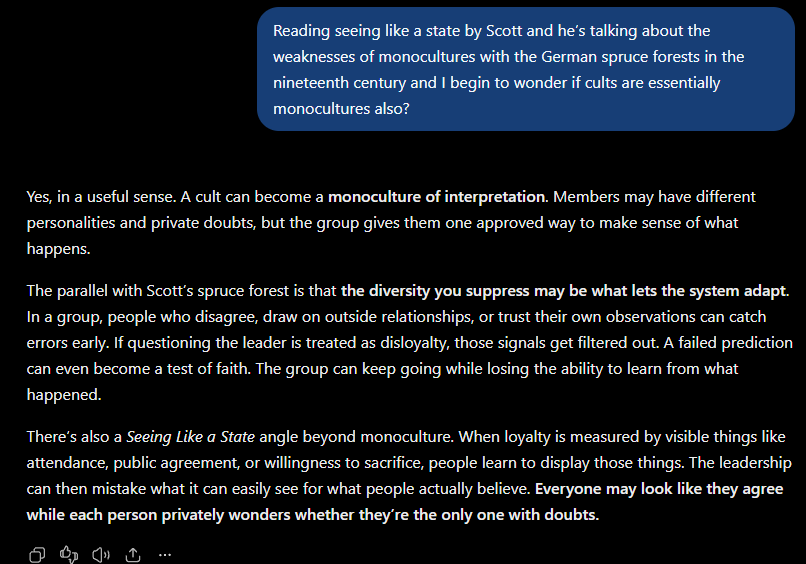
The only humans that could have ever even made that connection at the end are others that have read this book.
It may surprise you, dear reader, to hear that Seeing Like a State hasn’t exactly posted up Harry Potter or Twilight readership numbers. But ChatGPT has. I dug deep to figure out how it could even make this “intuitive” leap and honestly neither it nor I can answer the question how it made that fucking connection. At no point did I bring in Scott’s concept of legibility — which is what GPT is referencing there — in my context. It made that connection itself from spruce monoculture to cult back to legibility and then back to an additional insight into cults.
(AI Editor Note from Claude: the leap to legibility is apparently “heavily discussed online” and it is less impressed than I am with ChatGPT’s leap so…there you go.)
I will never be as well-read or as informed as ChatGPT. I’ll never catch up. What, exactly, do I bring to the table that is truly creative and different from ChatGPT when it can make leaps like that?
No fucking clue. But I’m gonna read the book myself, I’m going to make the connections myself, and I’m going to enjoy expanding my own feeble human mind.
The other interesting thing, to me, is that this really puts the lie to creativity to some extent. The majority of my code is written by a machine now. And, pragmatically, it gets the job done just fine. I’ve never been one of those who got emotionally attached to my code or the “elegance” of it or whatever. Similarly with my writing and most other writing I consume - it’s rare for it to touch me emotionally. Almost all the books I read are...fine. And that’s about it.
But I wonder sometimes if we are approaching, or have passed, the point where only a genius can separate themselves from what AI can do with some electrical impulses. Nature, humans, and capitalism all adhere to the close enough for government work approach to life.
I’m really not sure. But if you’d asked me 10 years ago what divides me from a very smart computer program I would have told you it was my creativity and that’s now pretty shot to shit in some ways.
It’s a weird and scary place to be.
Slop is Rude
It’s fascinating sometimes to read people’s takes on books that I’ve read and see how completely different our interpretations are of them.
There’s a blog making the rounds about how it is “rude” to subject people to “AI slop” without taking ownership of the output and reviewing it yourself. In essence, if you haven’t made it your own then you shouldn’t expose other people to it without their “consent.” Now, mind you, if you were to send someone a forum post written by humans without “taking ownership” then...that’s perfectly fine. Because that was written by humans it has, inherently, what this author styles as “proof-of-thought” and is thus not an assault on your mind like AI Slop.
What’s particularly amusing, however, is that the author references Blindsight of all books to make his point. Blindsight, to my recollection, is actually a book about how humanity isn’t all that special because we have consciousness, and that consciousness is actually a limitation in problem solving. When we encounter intelligence without consciousness in the book, well, we get our asses kicked. It’s a book that scrapes away at how humans aren’t nearly as special or unique as we like to think. And yet the author even references this very stuff and talks about “human slop” themselves.
Humans make slop. AI makes slop. And it’s not rude to send human slop to other humans, only the AI Slop that was trained on the human slop.
AI “thought” is inherently less than human “thought” which, I think, shows an incredibly optimistic opinion of human thoughts. We are not that special.
This is something that keeps coming up in my head, this mild panic about AI. “Well, it can hallucinate and get things wrong.” Just like humans. “It gets confused.” Just like humans. “It is confidently incorrect.” Just like humans.
It learned it by watching us.
Mild panic and discomfort in the face of learning we are not that special does make sense, but I do think we need to eventually get over it. I think we need to be comfortable with the fact that we are not special unique things because of our ability to string symbols together to communicate solutions to logical problems. The machines are honestly getting better and better at that. They are getting more and more “human” even if they are just a Chinese Room.
What they will not achieve, at least as they are now, are the consciousness things that we don’t even understand. Love. Hate. Connection. Even faith. What makes us human isn’t our ability to write a three-act-play, or paint the Mona Lisa, or architect elegant world-spanning solutions. What makes us human is that we can feel something as we do these things. And other humans can feel something when they experience them.
An experience is not what you encountered but how you felt before, during, and after.
The algorithm cannot feel. You can. That should be enough without pretending that problem-solving is the domain of only us. Especially as it becomes more and more apparent that, while it cannot feel, it most assuredly can make you feel.
The Human Domain
What, exactly, is our domain as a human? What is our sphere of knowledge, influence, and activity as Merriam-Webster refers to it? I don’t know, and if you think you do I’m confident enough to say you’re wrong. This is the type of stuff philosophers have been arguing about since before we had the printing press. Maybe even before we had writing itself?
We’ve been looking up at the stars for thousands of years and, if we’re honest with ourselves, realizing that we are invisible to the Cosmos. All of Earth is nothing more than Sagan’s Pale Blue Dot and, I think, the advent of AI has suddenly thrust the whole of humanity into a spotlight where we’re realizing we just aren’t as special as we want to believe, we don’t rule over a domain nearly as vast as we thought we did, and the world is so much bigger than we can trick ourselves into believing. We are all Sagan’s astronomers now.
It has been said that astronomy is a humbling and character-building experience. There is perhaps no better demonstration of the folly of human conceits than this distant image of our tiny world. To me, it underscores our responsibility to deal more kindly with one another, and to preserve and cherish the pale blue dot, the only home we've ever known.
~ Carl Sagan
Squirt Says…
I feel like there is a difference between AI and human slop. To make human slop takes time, maybe not much, but still some time. A content farm like Lanky Box can't post thousands of videos in a day. AI can. A dude with no skills at all can get a chatgpt subscription and just pump in thousands of dollars, and the thing is it works. You've talked about how shorts hurt your attention span but AI is largely part of that.
Dad Responds…
Thanks for explaining to me what Lanky Box was. I do agree, AI is creating a scale of slop that is unrelenting. Thousands more games on Steam’s NextFest. Lots more crap videos and articles. Floods of AI-generated meeting summaries that nobody is reading. And I think you’re also right that it will lead to even more damage to attention span.
Perhaps the first solution is to understand and recognize quality. AI-driven quality production vs. slop. Content farms vs. using AI for polish. Most technology is just a force-multiplier and facilitator, so it just becomes a question of…what will you use it for?