


This post has a theme song from one of my favorite bands…I just sort of kept this on loop and probably fucked up my Spotify stats for the year already. Oops.

Nature and Nurture
I had a “non-traditional” upbringing. In the broadest strokes, I was raised by a stepfather who became an adoptive father, but Mom always made sure I was aware of my biological father. Starting when I was twelve, I visited him every summer halfway across the country. The only other thing I should mention is that when my mother remarried, consciously or not, she married someone completely opposite to my biological father. While they were actually friends with each other, I cannot come up with a single personal characteristic that my two fathers shared.
Two fathers. Sooner or later a version of this story comes out with anyone I spend very much time with. For my closest friends when I reference “my dad” the inevitable question is asked — “uh, which dad?” In retrospect maybe I could have picked like different titles or something but, alas, I just called them both “Dad.” I had the benefit of having one mother but two different fathers. And because they were so very very different I like to pretend this gives me an interesting perspective on the nature vs. nurture debate.
The story of reconnecting with my biological father is a story about reconnecting well after my most “formative” years were past. I was twelve years old. My biological dad had contributed the genetic material, had provided half of my “nature,” but then was almost entirely absent. My adoptive dad, whose last name I shared by this point, got all of my early “nurturing” years. My inclinations and family environment always existed in an interesting state of conflict. When does my nature win? When does nurture override?
I lived my childhood at a still point of the turning world. I was pushed. I was pulled.
Still Point
One thing about childhood is learning that the world isn’t fair. Justice is, at best, something to strive and hope for. Sometimes the best you can hope for is getting to choose what will suck. Other times all you really get to do is choose your perspective. Childhood is learning that you are not nearly as powerful as you feel you should be. Humans always have wants and desires. Rarely does the child’s world care. Shit, who are we kidding — adulthood is about learning and relearning the same damn thing.
The world ain’t fair.
So from our first breath to our last, we are breathing at this still point. The world pushes. We pull back. We dance. We breathe. We push the world, but the world pulls us along. Sometimes we grind away the sharp edges, and other times the sharp edges leave us bloody. We live in the churn.
And always there’s that rage of knowing that we don’t really have the power. We are subject to the winds of the world. At best, all we can control is ourselves. Embracing the still point inside yourself while the storm rages.
The only way to deal with an unfree world is to become so absolutely free that your very existence is an act of rebellion.
~ Albert Camus
Dialogue or Debate?
Part of embracing my own personal still point is loving personal conflict. If the world is all mud then why not be just another pig wrestling in it? I find wrestling in the mud to be both fun and educational. Though the intent matters so very much. Why are we wrestling?
In interactions I draw a distinction between a dialogue and a debate. The mechanics of each of these personal interactions are identical. You engage with the other side. Each trying to influence the other. Clarify. State beliefs. Ask questions. Listen. Rebut. Push and pull.
But the intent matters and is frequently ignored. In a debate, you’re engaging to win. In a dialogue, you’re engaging to learn. And it’s always a choice. Why am I fighting? Why am I engaging? Am I here to win or am I here to learn? Why, exactly, are we in this mud?
Never wrestle with pigs. You both get dirty and the pig likes it.
~ George Bernard Shaw
I embrace being a pig. In fact, I argue that we should all be pigs. We should all learn to love wrestling in the mud. Because when you’re just there for the fun of it you are engaging in a dialogue. You are there to learn.
Lose or Learn?
The world is mud. You cannot change that. You don’t have that kind of power. You will always be in the mud and you cannot win.
Everyone understands this down deep, that they cannot win. The world is not fair, and no amount of raging or debating will change it. You are your own personal still point with a storm raging around you that you cannot stop.
The only thing you can master is yourself. There in the eye of the unstoppable storm, wrestling in the mud where you will always lose, you have no agency or control over anything but yourself. All you can do is embrace the push and the pull.
I was a child with two entirely different fathers who embraced what each could give me. I am a human surrounded by injustice trying to learn from the world. I don’t seek to win the debate, only to live in dialogue. To wake up having learned something about myself and the world I didn’t know the day before.
Not Trying
The looming thought here, at least for me, is that this is an argument to not even try. If you will always lose when you wrestle with the world then don’t try, right? Just accept every injustice and horrible thing in the world, focus on yourself alone. Focus on learning and being happy or what have you. Why not lock yourself in a monastery for the rest of your life and seek inner peace?
It’s a fair criticism. I’ve always felt like the Buddhist monks who’ve opted out of the world in favor of exploring the spiritual realm of their own mind are incredibly cowardly and selfish. But I’ve also always yearned to be brave enough to do what they do, to peel away everything that makes them an individual in search of the perfection where there is nothing else to take away. I do love paradox.
But consider, if we all were Buddhist monks would the world be more or less just than it is today? If we all embraced disagreement as a dialogue for us to learn from, would the world be better or worse? The path to justice is not avoiding conflict, the path to justice is about conflict for the right reasons. Conflict to learn and understand, not to win and conquer.
Embracing the push and the pull of the world means participating in that very push and pull but doing it from a desire to learn. We will all fail sometimes but, after all, we already know we cannot win so what’s the harm in trying?
Squirt Says…
I like how you use the phrase, “We will all fail sometimes but, after all, we already know we cannot win so what’s the harm in trying?” It shows we are just human. We make mistakes. We embrace those mistakes for they are how we learn, they are how we get better. If we never made a mistake we could never learn.

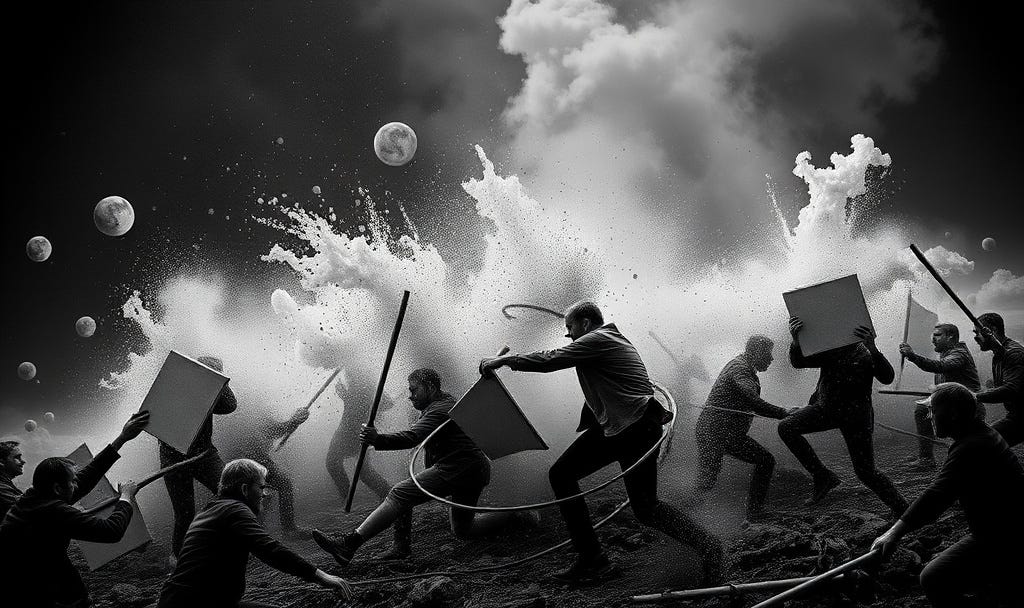
I generated a couple different images with the prompt “push and pull chaos” and this one is my favorite. The more you look at it the more “what the actual fuck is going on” you will get out of it. Simply incredible.