Squirt took us antiquing last weekend. I think the plan was for him to get a phonograph for his Edison Cylinders that he picked up while on vacation. Alas, we found neither cylinders nor a player. Player was gonna be outside our price range anyways. He did find a Beatles Anthology DVD set for $20, but only about half the episodes actually played when we got them home after 21 years of being who-knows-where.
I love that my kid is a nerd like this but it’s not actually my point today…
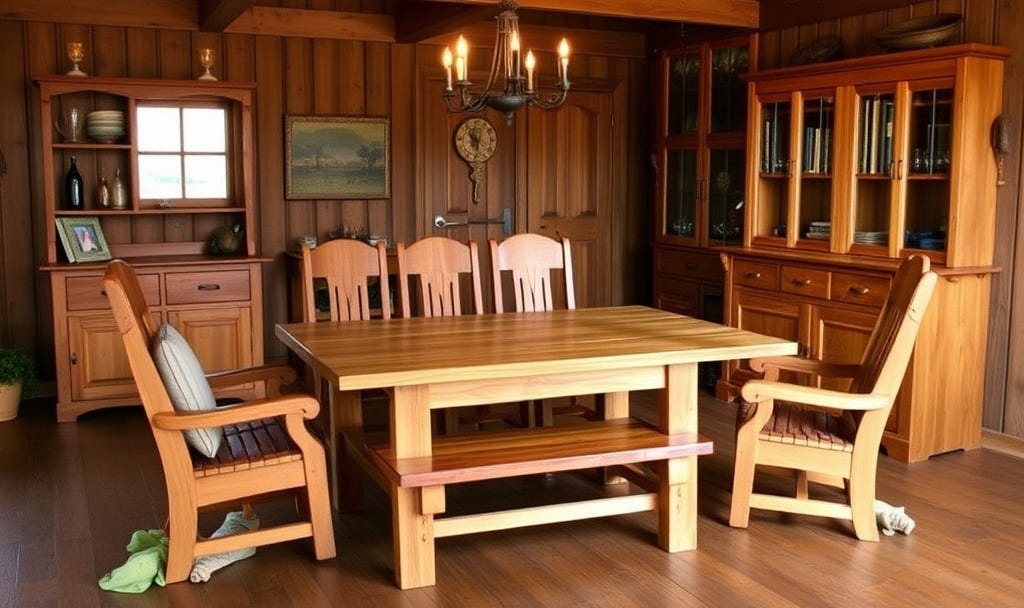
There was an Amish furniture store next to one of the antique places and that opened a huge conversation for a big part of the drive home. We talked about how much higher quality it would be, and the exorbitant cost associated with it. Then we wandered off into talking about Rumspringa and how frequently the young folks still come back to be baptized. It’s virtually everyone that comes back and the sociologist in me waxed on a bit about why this is inevitable. Between indoctrination and being raised in a monoculture, what else could they possibly know or be comfortable with?
Again, I wander from my point.
I am flighty today so I’m going to shortcut stuff and jump straight to a cheat sheet. I asked ChatGPT to give me a quick summary of Amish furniture and immediately this passage jumped out at me about the tradeoff with getting furniture from them.
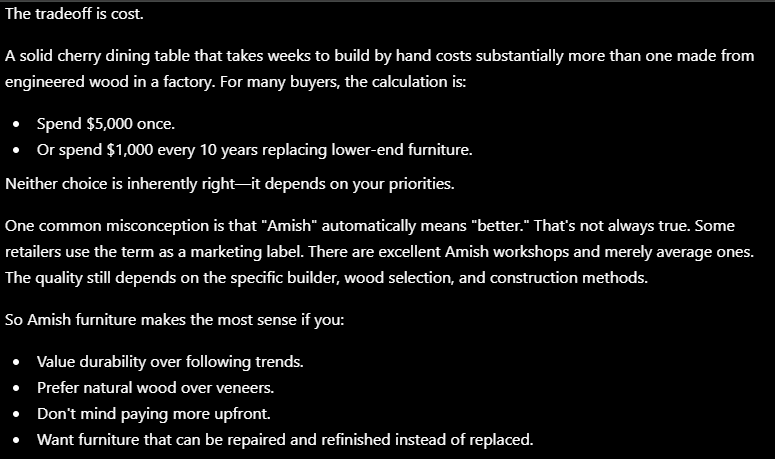
It’s like my entire fucking post right there. Sigh.
Craftsmanship
I’m a shit woodworker. I build with 2x4’s. I have done shelves and workbenches and aquarium stands. Chop saw, tape measure, impact driver. I can slap some shit together pretty quick and, you know what, it’s ugly as sin but it’ll do its damn job and hold lots of weight or a box full of water and it won’t fall apart the first time I put a broken piece of equipment on there and use some percussive maintenance. But my stuff doesn’t ever reach the point of getting to go into the house.
On the other end of this spectrum is Amish furniture. Handcrafted with hand tools over weeks. It is expensive, durable, and of the highest quality if you find the right piece. Something your great-grandchildren can still have in their house, and something that can be repaired virtually forever. Somewhere in the middle is where most of us live, though. Furniture from Ikea or Walmart or Rooms To Go. It is, as with so many other things, a spectrum.

Some software engineers frequently refer to themselves as “craftsmen” and I’ve always found it a little cringe. I’m not building art, I’m solving a problem. And if I’m good at my job I’m going to solve that problem in the most cost-efficient way possible for the company I work for. It is also not generally a solution that needs to last the ages. It will be tweaked and changed and destroyed and rewritten over and over again.
You’re not building Amish furniture, don’t call yourself a craftsman.
The reverse, though, is also true. You’re not building something out of 2x4’s. It needs some level of durability. Reparability. It needs some fucking elegance. But, goddamn it, it also needs to work.
I was reading a piece today about how the hobbyist programming community is very against LLMs. In the very first paragraph I encountered this passage:
“...the process of mastering a difficult field itself is the product, and something that runs is generally a nice-to-have.”
Something that runs is a “nice-to-have.” Oh the joys of being a hobbyist. The joys of being a craftsman. It’s just “nice” to have something that actually solves the problem. The important part is that you had fun doing it and that it was elegant.
It’s just not my bag.
Utility
I’ve never wanted to build Amish furniture, metaphorical or for real. I love making useful things but once the solution is mostly solved, once I’m 80% of the way to that perfect solution, it’s close enough for government work.
If you dig deep enough into any piece of furniture, or house, or complex programming solution, you will find things that suck. But the higher up you are the more difficult it is to see those flaws. Instead the question becomes “does it do what it is intended to do?” The reality is that the question of “does it do this well?” grows less important. Not unimportant, I think that’s the 2x4 solution, but less important. Somewhere in that Rooms To Go range, because that gets the job done good enough.
There will always be a culture of artistic craftsmanship. Hobbyists. Elegantly designed solutions that approach perfection where the craft has been handed down from master to apprentice. This, I think, is part of the shakiness right now - everyone is needing to figure out where they land on that gradient up there.
There are those that will shun the LLM entirely. Call them the Amish programmers.
There are those that will uncritically accept everything the machine throws at them. Call them the vibe coders, and I hope to hell they’re never programming my medical equipment.
Then there are those somewhere in the middle who see this as a fundamentally empowering moment where they can still build amazing things but their role has changed. Call them the problem solvers.
The story of technological progress is doing more faster, and that’s the freedom I see coming for me. There will always be a niche for the highest quality. For the vanity. For the artistry. But things become revolutionary when everyone is empowered, and that’s how I see the flow of technology this year.
Squirt Says…
I would say that I probably would not get Amish furniture because that would require staying consistent — meaning to make my money back I would need to stay with it for 5 year or something and I like change. I will be a different person 5 [or] 10 years from now than I am right now and feel that like you said close for government work if it works then it works.
Dad Responds…
It’s a great point for furniture and for software. Tastes change. People change. What was the perfect solution doesn’t remain as such and you may regret having sunk so much time, energy, and money into a particular approach. Perhaps another nudge away from that pure “craft” idea.