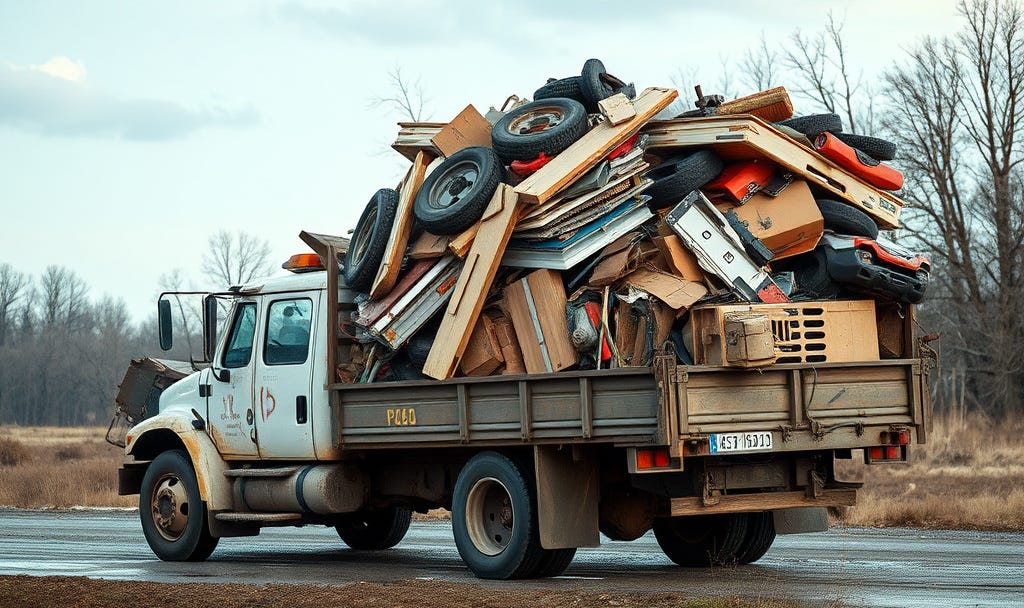
If I’ve managed nothing else with Squirt, at least he has learned here at my side one of the most all-important concepts in the world. A concept I myself learned at the side of my own father. A concept so fundamental to living in the modern world that everyone should know it and love it:
Close enough for government work.
Sure, it might be a little crooked but it’s hanging on the wall. That thing there might not quite line up or be level but, really, who can even tell? I could use a couple more straps but as long as I don’t drive fast that thing won’t be going anywhere. I missed a spot with the paint but the paint can is already put away so…you know…close enough for government work.
I actually hate Dad Jokes. I have friends that make them or send them to me just because they know it irks me. Wordplay, puns, all that stuff just doesn’t do it for me. But this snarky comment about poor solutions aimed at the government? Sign me up. If I had to describe the government in a single word it would, I think, be “imperfect.” I like to think that the Founders would agree, seeing that they created a government that was supposed to adapt and grow with time. Not sure how well that’s worked out as most times when I interact with the government I am forcefully reminded more of my one word description. So that phrase…it’s funny ‘cause it’s true.
Beyond the Joke
But deep inside this joke is actually a foundational aspect of the way I view life that I think is important, healthy, and powerful. The ability to accept imperfect solutions. The speed of solving “good enough.” The value in acceptance, not through inertia, but through a conscious choice. The recognition that there is always, every single time, a trade being made.
One definition of a good death is that you die with things left undone. Because if everything is done then that means you ended up living a life where you ran out of goals. You died without even striving. Horrific. Give me a death where I’m begging for more time because there’s one more thing I want to do. A new book to read, another conversation with a loved one, one more thorny problem at work, one more beautiful sunrise. I want to always be living a life with another thing around the corner. I want to die with a to-do list still sitting there.
Thus the trade. Reading a book means I’m not talking to a loved one. Talking to a loved one means I’m not fixing that creaky hinge on the bathroom door. Playing a game means I might just reheat some crappy poverty nachos for dinner because I don’t have time to cook something real. I am sometimes painfully aware that when I’m mowing the lawn I could instead be watching a movie in the air conditioning. There’s always something else I could be doing, and there’s always something else to be done when I finish what I’m doing.
So I just need it to be “close enough” for me to move on to the next thing. I’ve got other shit to be doing. Perfect is the enemy of good.
Choice
Most of my arguments with other professional engineers fall into two categories:
Should we solve the problem?
How should we solve the problem?
First is the question of if we even need to solve the problem. Some of these are easy - production is on fire, we cannot do business, two decades worth of financial documents have been accidentally deleted. These are problems that must be solved but others…should we add yet-another-tool? Should we govern this or allow freedom? Should we create optionality here or have a single path? Choosing to solve a “problem” is choosing to focus on it instead of something else and there is always an opportunity cost.
Assuming we’ve chosen to solve the problem then now we need to discuss how to do this. Enter the really fun arguments. Nobody can argue like some fucking nerds about an inconsequential detail. I’ve lost count of the times where “consensus”, if it’s even achieved, ends up just being who gave up last. But it’s really about getting “close enough” or trying to reach the Platonic Ideal of how to parse that shitty log output.

I’ve got better things to do.
Usually.
Zen
I’m bad at being Zen. I’m grumpy, easily irritated, and much of the world tends to operate like sandpaper on my brain. But I try and one thing I’ve always been able to do is let something go. Turn in the paper rather than read it one more time. Publish that Substack. Commit that bug fix. Turn the water back on and look for leaks.
Move on. I mean, assuming that pipe isn’t leaking…
I love solving problems, but I do not need to solve problems perfectly. I think it’s important to “be Zen” about this shit. Important to be water. Important to adapt. Accepting imperfections is a strength. Lao Tzu predates Zen Buddhism but…
“Water is fluid, soft, and yielding. But water will wear away rock, which is rigid and cannot yield. As a rule, whatever is fluid, soft, and yielding will overcome whatever is rigid and hard. This is another paradox: what is soft is strong.”
~ Lao Tzu
Perfect solutions are frequently brittle solutions. The closer you get to "friggin’ Plato” up there the more inflexible something becomes. More importantly, the more time you spend on something.
Be. Water.
Where to Land
I’m not sure I really managed to weave these things together but the obvious joke is obvious: I think it’s close enough for government work. The tension is where to land for all the questions. Just how Zen should somebody be? What’s an acceptable level of “close enough” for you? Is the problem really solved? Phaedrus went mad trying to answer that very question. I think empirically answering that question is unreachable. To quantify when something is “close enough.” Nevertheless, if Squirt learns anything, I hope he learns to walk that tightrope between obsession with perfection and not stopping until the job is done.
Squirt Says…
I agree with how you need to balance perfection with a lousy job. Good is the enemy of great. If you were to spend all your time working, trying to get to perfection, you would simply not have any time.
Dad Responds…
I really like “good is the enemy of great” and I’ve never heard it said that way before. It speaks to the tension and adversarial nature of accomplishing tasks. They do oppose each other. They are “enemies” from either direction.