Premium
I pay a yearly fee for two different services that have free alternatives. The first is my national newspaper, which I get from The Dispatch. The second is my personal money management software from Monarch Money. I think both of these bring far more value to me than what I spend for them each year, which is why I will happily signal-boost them. I like these products.
Each of these companies made some “interesting” moves in the past month. On Monarch’s side they’ve come out with a “plus” offering that doubles the price and adds retirement forecasting. The community is pissed. On The Dispatch’s side, I suddenly got a banner ad thrown in my face for the first time after years of reading every morning without a single advertisement. The very next day the editors had a big blurb about it because the community was pissed:
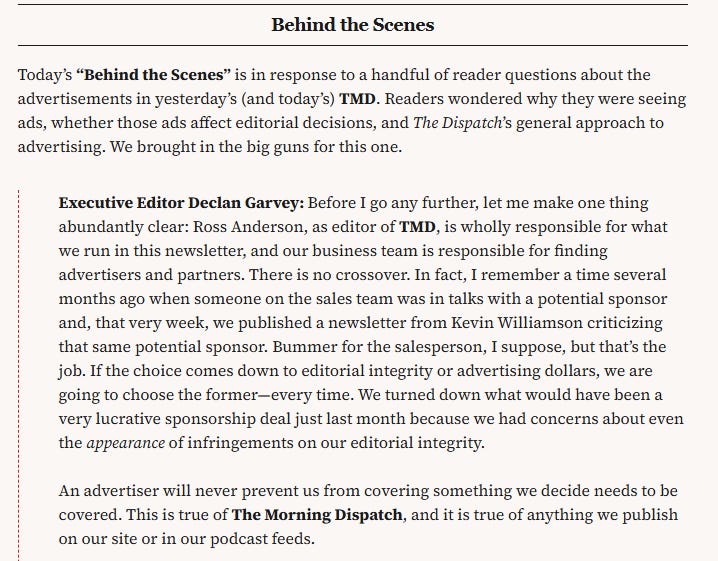
Further into that response was a mention of the “Premium” subscription and how that one would remain free of advertising. It is, of course, 2.5 times as much money to get the Premium subscription.
Similarly, we now have streaming services introducing ad-free “premium” tiers. All of a sudden Netflix is showing me advertisements? Really? Unless you pay more and then they’ll happily get rid of the ads. The plan for all of these is simple: weather the shitstorm of people raging and then enjoy your increased margins and advertising revenue. Few will walk away over just a little more pain. Boil the frog.
I keep flailing in my head trying to turn what’s rolling around in my brain into text this morning but I just keep getting examples of the “thing” rather than the “point.” So here’s another one: ChatGPT is serving ads now to their free tier. Anthropic/Claude explicitly refuses to do so even unto doing Super Bowl advertising about how they don’t do advertising in their platform. Essentially the exact same product with the exact same goals but entirely different approaches to how to do so. Both, of course, also encourage a “premium” tier to get even more services but Anthropic (the one without ads) is wholly dependent on those premium and business tiers.
This final example came weeks after I had written lots of this and let it languish in my drafts, but I think it finally “clicked.” There are now venture capital firms creating healthcare solutions that cut out health insurance companies. There are a couple things in that piece that I focused on. First, that these companies are breaking away from traditional models for healthcare. Finding gaps they can fill. But also that this isn’t meant for everyone. Not everyone can spend $365 a year per person just to get test results. It is, by its very existence, a “premium” offering.
News media. Financial Software. Television. LLM chat services. Healthcare.
Over and over again the general categories of consumption have been jumping into my head:
No Consumption - you are fully the product
Cheap Consumption - you are part of the product
Premium Consumption - you are paying to not be the product
Optionality
Squirt and I have a thing. I ask a question I’ve asked a hundred times, he rolls his eyes and answers with the same answer every time.
Dad: “What does money get you?”
Squirt: “Options.”
Capitalism in a nutshell — wealth is directly tied to optionality. The more wealthy you are, the more choices you have. The poor and middle class have to pay their own taxes, and it’s a luxury to have someone to do your taxes. We have to watch advertisements. We’re lucky to get 15 minutes with our doctor for a checkup. The rich have ways to move their wealth around that avoids taxes along with professionals who exist just to shelter this wealth. Personal doctors. Personal trainers. Personal chefs. You know, “premium services.”

Success to the Successful
I just finished Thinking in Systems by Donella Meadows and there is a system “trap” that she talked about called “Success to the Successful — Competitive Exclusion.” The simplest definition of the trap is that when you start ahead it’s easier to get ahead and to keep getting further ahead. Her first example was Monopoly, which amused me because that factored into the opening sentence of one of my own system meditations where I wrote about Balatro. The first person who manages to start building their hotels (because they were lucky) is almost always the winner. In ecology it is called the competitive exclusion principle and it leads to one species outcompeting another. In the human capitalist world you can simply replace species with income level. The poorest children get the worst educations. The lowest earners get shitty payday loans with exorbitant terms because it’s all that’s offered to them. The middle class might avoid those but can easily fall into the credit card trap. Banks and casinos fight over the rich whales though and offer terms that you or I will never see.
This is something we all understand. It’s the system we live in. It’s expensive to be poor and it’s always easier to get rich when you’re already rich.
Success to the Successful.
Choosing
To be wealthy is to choose the premium service for everything. To be poor is to have almost no choices. To be middle class is to have choices that matter. To be rich is to have time for whatever you want. To be poor is to have no time. To be middle class is to have choices where you will put your time. This, I think, is what is whirling around in my head. This is why this has been bugging me. We exist in a place where choices and time are scarce.
How do we make good choices? How do we not get overwhelmed? How will Squirt not get overwhelmed? How will I teach him to make the right choices?
Fatherhood in a nutshell, right? If the goal is to teach your children to function on their own then you need to teach them to make the smart choices as much as possible. Unfortunately in the world as it exists right now I think that means the first answer has always been making smart financial choices.
Rule One: Don’t be Stupid with Money.
What a fucked up rule one. My mom’s rule one was “money doesn’t buy happiness.” But the truth is that money does buy you that optionality, and having choices is the quickest path to happiness. Money means freedom. And can you truly be happy without freedom? So be smart with your money and try to maximize your freedom.
Pissed Off
I think this is actually why these new premium tiers are pissing me off. Because now I’m seeing advertising in my paid for news. Now new features that I want from my budgeting software are locked behind a doubling of the price. If I want the good ChatGPT then I need to cough up some cash. If I want the best picture of my health then I need to start budgeting for that also. If I want to watch my fucking Netflix program without ads then it’s time to figure out where to put that in the budget too.
Or reconcile myself to seeing my experience diminish. The only smart decision is to reconcile myself, because I can’t pay for all the premium tiers. Not without violating Rule One. This sucks. Short of winning the lottery, though, that’s our lot in life — to choose which premium tiers we don’t get. I’ve never needed a private chef, but I sure as hell have gotten used to not looking at advertising.
The thing is, these are net increases in optionality. Growing up the nightly news and the newspaper were the only options for being informed. Now there’s a million options. The only medical tests you got were what your family doctor ordered. Budgeting was wildly more complicated and time-consuming. Television always had advertising, you just accepted it. You had no choices, really, for many of these things. It was undeniably a “simpler time.”
I sometimes think this is where lots of the rage comes in the modern world. The choices available. Quantitatively, virtually nothing is worse now than it was 20 or 50 or 100 years ago. The world is awful but getting better and we can do better. It’s irrational to look at the days gone by and think “it was better back then.” It was simpler back then of course. There were fewer options. And with options comes choices that must be made. Cancel Netflix or AppleTV? Pay for the news or become the product? Where must you trim the budget?
On the one hand, it’s a glorious thing to have all these choices. To have the freedom. On the other, freedom requires you to choose and choosing well is hard and frustrating.
Squirt Says…
The problem is poor people are always the product they have no choice on whether to deal with the ads or to pay for them. On the other hand, rich people have enough money to throw around that they don't need to make any choices at all. Pay a tiny bit to get rid of an inconvenience that bothers you makes sense doesn't it. However, people in the middle class have to manage it to budget it is getting rid of an inconvenience really worth it or should I just learn to deal with it. Choices Choices Choices.
Dad Responds…
Great thoughts. Explains why I have an entire tag just about “choices.” Also why there’s lots of research to back up the richer a country the higher their life satisfaction. I do disagree about rich people not having to make choices, it’s just that they have so many options most of their choices have many more options so they can also find a “good” choice. It’s interesting, though, that there is some debate if there are diminishing returns as you get more and more rich compared to happiness?