


I cannot visualize my spouse or my child. I cannot visualize anything.
Try this: picture an apple in your head. You see it? Does it have a color? A stem? A bruise? Is there anything else around it? Is it shiny? Dull? Juicy?
For me — a void.
The Wikipedia entry for aphantasia has incredibly detailed reading but I particularly like the image at the top with the apple. I’m a big honking number 5 when I “picture an apple” in my head.
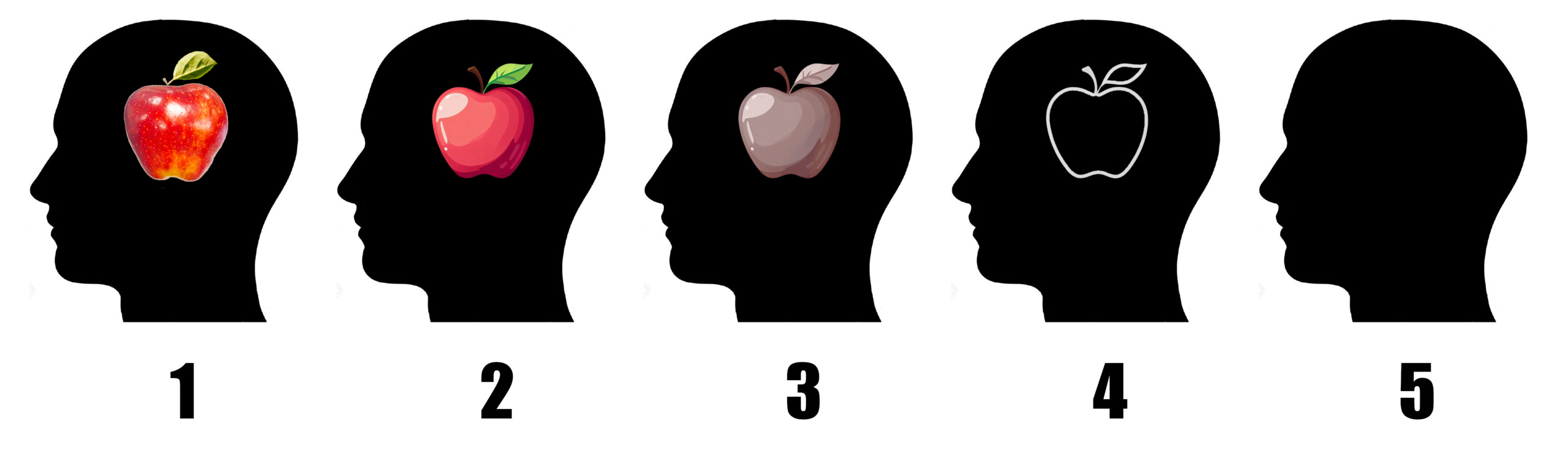
The stories of how someone realizes they have aphantasia all smell similar to me. Mostly it’s tied to the word itself. We don’t typically talk about how our minds work, or what we “see” in our brains so it starts with the word. A word that’s barely a decade old at this point but has come up over and over again. Giving definition to something is the first step to recognizing it.
I heard about aphantasia very early after it was coined in 2015. I’ve well and truly lost the article that talked about it originally but I remember the relief I felt reading that article. Here was the explanation for why all those “tell me what the criminal looked like” sketch artists I saw in media didn’t make any sense. Here was why I couldn’t “visualize” something and meditate on it. Why things like a memory palace didn’t make any fucking sense. You can imagine you’re standing in a room? What the fuck?
This, finally, named why I couldn’t close my eyes and see my spouse’s smile.
It was an answer to a bunch of the million questions I carry around in my head at any given moment. And, then I moved on. It’s nice to have an answer but this didn’t really change my life. But then over the years it started coming up again and again.
An author I like wrote about it in 2020 and this introduced me to something I hadn’t really considered: other people thought I was fucked up. That I had a “disability.” So I started mentioning it in public more often, deliberately. Because the more folks that hear the word the more folks might realize that, yes, they are different. But also because, like Mark Lawrence in that piece above, I don’t think there’s anything wrong with me.
And then recently this New Yorker article came out. I’m not going to link to it because fuck the New Yorker and its haughty condescension. But I will link to a reddit thread that discusses it. There’s a free version of it there as well if you want to read it. There’s some good stuff, I suppose, but in between the lines it’s coming from a place I thoroughly despise: a place that says being different like I am is a “disability.”
Words Matter
The word disability is defined thus in Wikipedia: Disability is the experience of any condition that makes it more difficult for a person to do certain activities or have equitable access within a given society. The rest of the article also makes for some very interesting reading. There is much baggage with this word and it includes lots of emotion and fuzziness. So, rather than try too hard to give a strong definition, I’m going to work off a continuum or spectrum to try to capture that there is a range of being disabled. Rather than say “picture this” ‘cause…you know…I can’t…

Let’s put someone heavily disabled on the right “blue” side and someone who is not disabled on the left “red” side.
On the extreme right side let’s imagine someone who cannot function on their own. Perhaps they have physical disabilities like the inability to feed, walk, or bathe themselves. Perhaps they can only live because of bulky machines that must travel with them everywhere. In the middle let’s imagine someone who has fewer difficulties but still very much has them. Perhaps an amputated limb. Or someone who is blind or deaf. And on the extreme left side is someone without disabilities. All body parts in working order, in possession of all senses and physical abilities. Someone you might call “normal” and mean that they have no particular struggles.
The physical spectrum of disabilities is something I think most folks can wrap their head around. And the idea of locating someone on this spectrum is pretty intuitive. But take a moment to realize you can get more detailed. I don’t belong on the extreme left and most folks reading this don’t either. I’m overweight. My knees are complete shit. I cannot shoot a bow and arrow right now because I copped off a piece of a finger. The 17-year-old basketball player is quite a bit further along on that spectrum than my old broke ass. LeBron James is on the extreme left, not you.
When I think of disability I, generally, use the physical flavor in my head. What physical activities are disallowed or made very difficult. But there is a different flavor…
A fucked-up mind.
Anxiety. Depression. Schizophrenia. Sociopathy. Narcissism. Seasonal affective disorder. Autism. Attention-deficit/hyperactivity disorder. Dyslexia. Aphantasia?
Mental “disabilities” are much more complex.
Something I’ve told Squirt from a very early age is that everyone can teach us something. Embedded in that sentiment is that everyone’s mind works differently. You can learn from everyone because everyone’s mind has a different perspective. It’s part of why empathy is a super power. Physicality has never been that important to me. There can be enjoyment in athleticism, of course, but the days where the athlete was meaningfully impactful to society are long gone, if they ever even existed.
The mind is what moves civilization. The mind is what changes the world.
And minds that move civilization all share some of the “disabilities” above. Anxiety and depression are rampant, yet civilization moves. Some of the greatest minds of humanity were autistic or dyslexic or had ADHD. I don’t think there’s a politician ever born who wasn’t a raging fucking narcissist. If normal is simply conforming to a standard and being “typical” or “expected” then having a fucked-up mind is actually what is normal.
Someone with a broken back wants to walk again, that is their normal. Someone missing their leg wants a prosthetic so they can be more “normal.” Someone who is blind will never be “normal.” You can point to where you want to be, or where you cannot reach.
But with the mind there’s no such thing. We all walk using the same mechanical process of moving our legs, but nobody’s mind moves the same. This is a beautiful thing worth recognizing. We’re all a little mad here.
“But I don’t want to go among mad people,” Alice remarked.
“Oh, you can’t help that,” said the Cat: “we’re all mad here. I’m mad. You’re mad.”
~ Alice’s Adventures in Wonderland by Lewis Carroll (suspected to be autistic)
Of course, it’s never this simple. Some of these mental disabilities are undeniably debilitating. We even use physical-coded words to describe them sometimes. Crippling depression. Paralyzing anxiety. You can’t wave your hand and say “everyone is fucked-up so just accept it.” Someone with a broken back is learning to walk again, that’s their end goal. Someone with a “broken” mind should have an end goal in mind as well but the definition of a “fixed” mind is not nearly as simple as being able to walk again. And of course not all problems even have a solution - there is no medicine, surgery, or mental training that can give my mind the ability to see things in my imagination.
By their very nature, mental disabilities are entirely unique to each person. Maybe they need to be fixed, maybe they will always be around, and maybe they aren’t even a bad thing but just part of who you are. And whether you even call it a disability is a personal choice.
I cannot picture my spouse or my child when I close my eyes. I cannot change this. But I can choose how I see this ability that I lack, and what I choose is to shrug and say I’m pretty happy with the way my mind works. My mind lacks many things that others have. I in turn have many things that others lack. And you don’t get to tell me I’m disabled, or emotionally maladjusted, or unable to remember the path of my life because of a label that isn’t even as old as my child.
Squirt Says…
Is this why you always preferred only word books over picture books? Everyone is a little different in some way or another. Instead of trying to be normal we should embrace this.
Dad Responds…
Good question, this might be why I like books with words instead of something like graphic novels. I had to learn how to pay attention to the pictures and even today I can’t actually tell you which parts of Superman are red or blue, I just know he has an “S” on his chest. Same with Spider-Man having some web stuff on some of his costume. And, yes, “normal” is overrated.
Sorry to hone in on what is clearly not your point, but I have a question: as a prolific reader, how do you process visual descriptions? What about other sensory descriptions? Are you able to simulate hearing the wind in the trees, feeling the breeze, smelling the air? I saw the articles about aphantasia when they first came out, and it really interested me, I think partly because I'm on the other end of the spectrum: my meditative sessions often involve a partially or fully (difficult) simulated environments, and one of my favorite things about books is how I can transport into that world entirely, effectively escaping reality for a while. Closing the book is like waking up from a dream.
I also have aphantasia. Sometimes I think I can see one portion of a person's face at a time if I concentrate really hard, but I think I'm just fooling myself because a flood of descriptive words flow in my brain. So the part that really amazes me is how incredibly vivid and detailed it seems like my dreams are, like watching movies on the big screen with all the details and colors. How can those two things be from the same mind?