


There’s never enough.

As of today the Wikipedia entry on scarcity sums it up like this:
scarcity refers to the basic fact of life that there exists only a finite amount of human and nonhuman resources which the best technical knowledge is capable of using to produce only limited maximum amounts of each economic good.
The phrase “basic fact of life” appeals to me. This basic fact touches each person each day. I think we sometimes forget just how much of not having “enough” drives everything around us. Or “the economy” if want to handwave it away.
I’m not going to navel-gaze on economics. I swear. But I want to set a baseline. I once learned that an easy way to understand the value of the money in your pocket is to look at how many meals you can buy with it. The closest analog I can find today is the Big Mac Index which asks a question of how much a Big Mac costs in different countries to understand relative currency valuations.
A more “official” flavor might be real wages which can be expressed as buying power normalized to a particular time. Note that over the last two decades it’s been almost entirely flat. We make more money, we cannot buy more stuff. People continue having to choose what they will not have. The heart of scarcity is not having something.
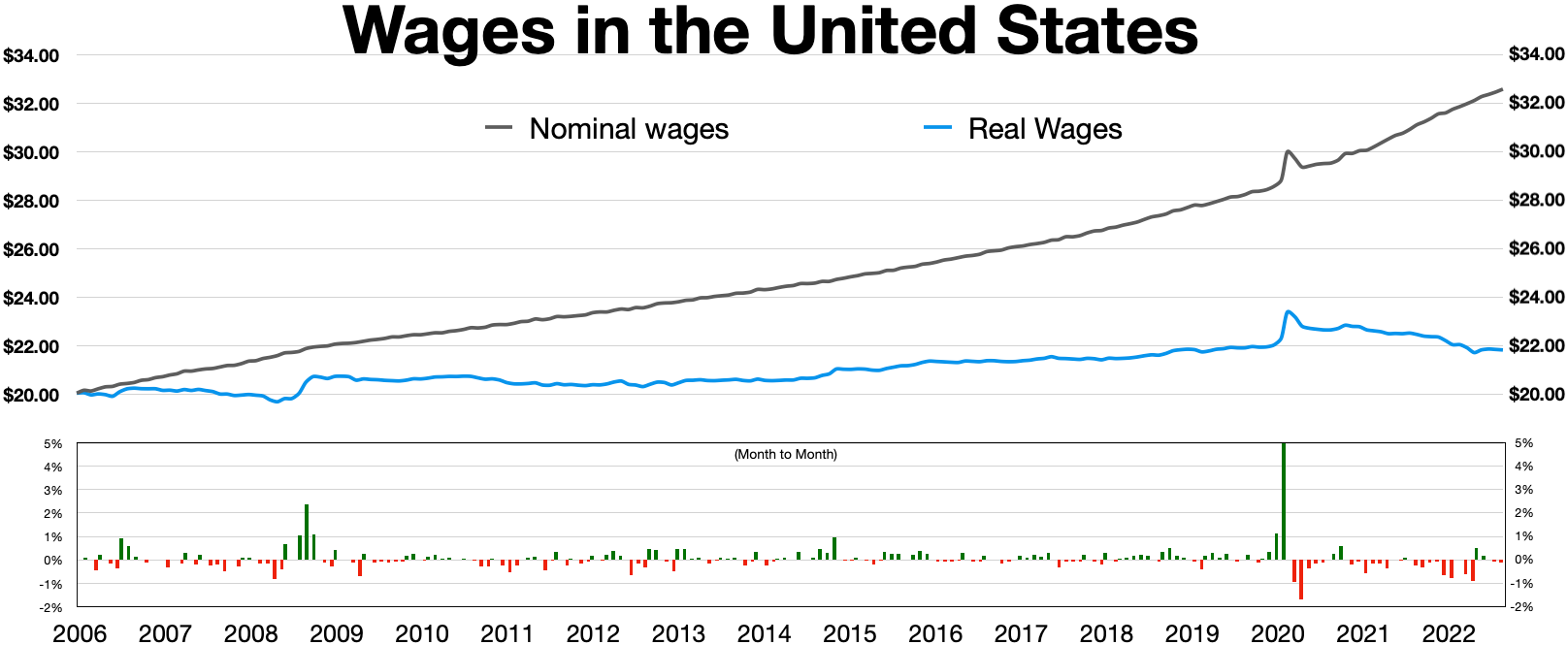
But there is more to the story of course. One might look at that and be enraged. Indeed, look around at the US and you’ll see exactly that rage. But I am relentlessly optimistic just like Max Roser.
The world is awful. The world is much better. The world can be much better.
~ Max Roser

Motivations
Three hundred word digression aside, my point is that scarcity is foundational to our lives. And because it is foundational it drives much of the world and allows us to analyze things that happen in a way that I think can sometimes be lost.
My favorite climate analyst from Our World In Data had a piece recently about the oil reserves of Venezuela. Not coincidentally she posted this the day after Trump kidnapped the dictatorial leader of Venezuela who wasn’t pumping the oil like the world, and the US, would like. There have been many other supposed “motivations” and, indeed, we’re barely even talking about it now in the US because it’s been like a week or two. Instead we’re now talking about the possibility of invading Greenland with a motivation that appears to just boil down to “they have something we want.”
Like any other system, you have to make trade-offs. The examples happening in America right now were exactly the same - trading away stability for an imagined economic boom if Trump were reelected.
I think this is an important lens to explain many decisions. Interestingly when I discussed this with GPT it was like “no, you’re wrong, scarcity doesn’t drive decisions that limit optionality.” It gave me examples like marriages, contracts, and principles as other motivations that flew in the face of scarcity. I didn’t bother to disagree with the machine but it is wrong in this case.
Every decision closes doors or “limits optionality.” You enter a contract that promises something for something else. Marriage is a vow to share your life with someone else. Better or worse. Sickness and health. We make these types of promises in part to eliminate scarcity, restrict entropy, and create more “order” in our lives.
Trump kidnapped a head of state because he wants more oil. I married Spouse because I wanted more of a partnership and life with them. Same vibes, right?!
Novelty
Joke aside, I see the same vibes today in something that seems completely unrelated. Stratechery did an introspection on being a content producer during the age of AI. I came away from that post thinking a word that didn’t show up in the piece: “novelty.” Novelty is an incredibly scarce resource. It is the “human” element that still sets us apart — and I think it’s an element that we tend to have an inflated perception of.
We are not as special and novel as we tend to think.
But now I think we are having to face that lack of novelty. Like when we compare our writing to AI writing. Or with AI art. I use Substack’s image-generator for most of my pieces 0to get some hilarious images but, at the same time, it’s saving me all sorts of precious time and improves the presentation of my ideas. Sure the Oliver Twist up there asking for another Big Mac is absurd but I spent a whole 15 seconds making it.
I see AI as being powerful because it’s giving us back time. Time we can spend on, presumably, things that are more novel. The AI cannot write this piece even if it can save me time and be a tool for creating it with me. The AI will not replace human content production.
But it will take a big bite out of the commodity work. Writing the same API that’s been written a million times. Drawing a picture of a dumpster and a rainbow. Analyzing an X-Ray for cancer. Pulling out the relevant bits from a stack of metrics.
Or, to come back to our lens, AI is eliminating scarcity. But it’s doing it by exposing that what we thought was novel…isn’t.
Abundance
One way I’ve made value judgements is to consider how something is addressing scarcity. What scarce resource is being selected for? In the case of AI we are selecting for generic content - the regurgitation of semantic ideas that have shown up over and over again in training data. And it lets us save time. I think this will be a good thing, in part because I like to think I don’t labor under the delusion that I’m particularly special.
90 percent of everything is shit.
But that 10 percent is valuable. And I see things as moving in the right direction. Give me a generic foundation to stand upon and maybe I’ll create some novel connections. Maybe I’ll say something in a way that speaks to someone in a way that the AI never could. AI is just another brick in the foundation that human civilization has been building since we figured out how to talk to each other.
This same value shows up with my favorite website on the internet — Wikipedia. The single greatest gathering of human knowledge on the planet. It is the flower of the internet which, itself, has done more to democratize information than anything in human history. In Sapiens, Yuval Noah Harari breaks human history down into three revolutions: Cognitive, Agricultural, and Scientific.
I can strain that a bit to fit within a scarcity-of-knowledge lens. That is, humanity has been marching forward to create more knowledge for our entire existence.
Language (spreading knowledge)
Agriculture (more brains to generate knowledge)
Printing Press (persistent knowledge from brains)
Science (systemic knowledge gathering)
Industry (more time to generate knowledge)
Internet (knowledge explosion)
To me this is what Abundance is truly about. It’s why I want to see more and more energy. It’s why Starlink is one of my favorite technologies - because it’s bringing knowledge even despite authoritarian control in places like Iran.
There’s never enough. But if each year we step towards more then maybe that’s enough for me?
Squirt Says…
Scarcity is everywhere. Scarcity is horrible. Scarcity is movement forward. Scarcity is what pushes everything. Without Scarcity nothing can move forward. There is no greater factor to push than Scarcity. Scarcity is the reason we are where we are.
Dad Responds…
I chatted with Squirt a bit more to understand the “movement forward” line and he said:
Well without Scarcity we would simply do nothing there would be no problem to solve
Which I really like, because it shows that he’s thinking about problems to solve. And I think it ties in nicely with the motivation aspect I talked about at the opening. And it is indeed horrible. I’m not sure how many parents are teaching their kids to yearn for post-scarcity but I think it’s a useful lens.
When I read “it will take a big bite out of the commodity work”, I almost instantly converted it to “it will commoditize a big bite of work”. Important nuance imo.