Booze
I like whiskey. Squirt does not. More specifically, lest you think I give my child whiskey, he does not like the idea of me drinking whiskey. He recoils from it when it comes out.
And understandably so as I told him years ago that alcohol was poison. He took that to heart and, at least at this age, he is an inveterate teetotaler. In fact, he is so vehemently against it that as soon as the booze comes out I get the stink eye and commentary. Every. Time. Parenthood is grand.
He also took a video from one of our favorite YouTube channels and put it up on the living room TV and ordered me to watch it. I’m going to embed it here because it is amazing and, while you do not have to watch it to follow the rest of this piece, I would highly encourage you to check it out. And you can get a chuckle out of imagining me watching it while Squirt alternates between nodding solemnly at the screen and then giving me meaningful looks.

Divinity
Come with me down a rabbit hole that we can hopefully burrow back to my point. Take a look at this graph of world population over the last ~12,000 years of human existence. Even if you’ve seen this before, take an extra half second.
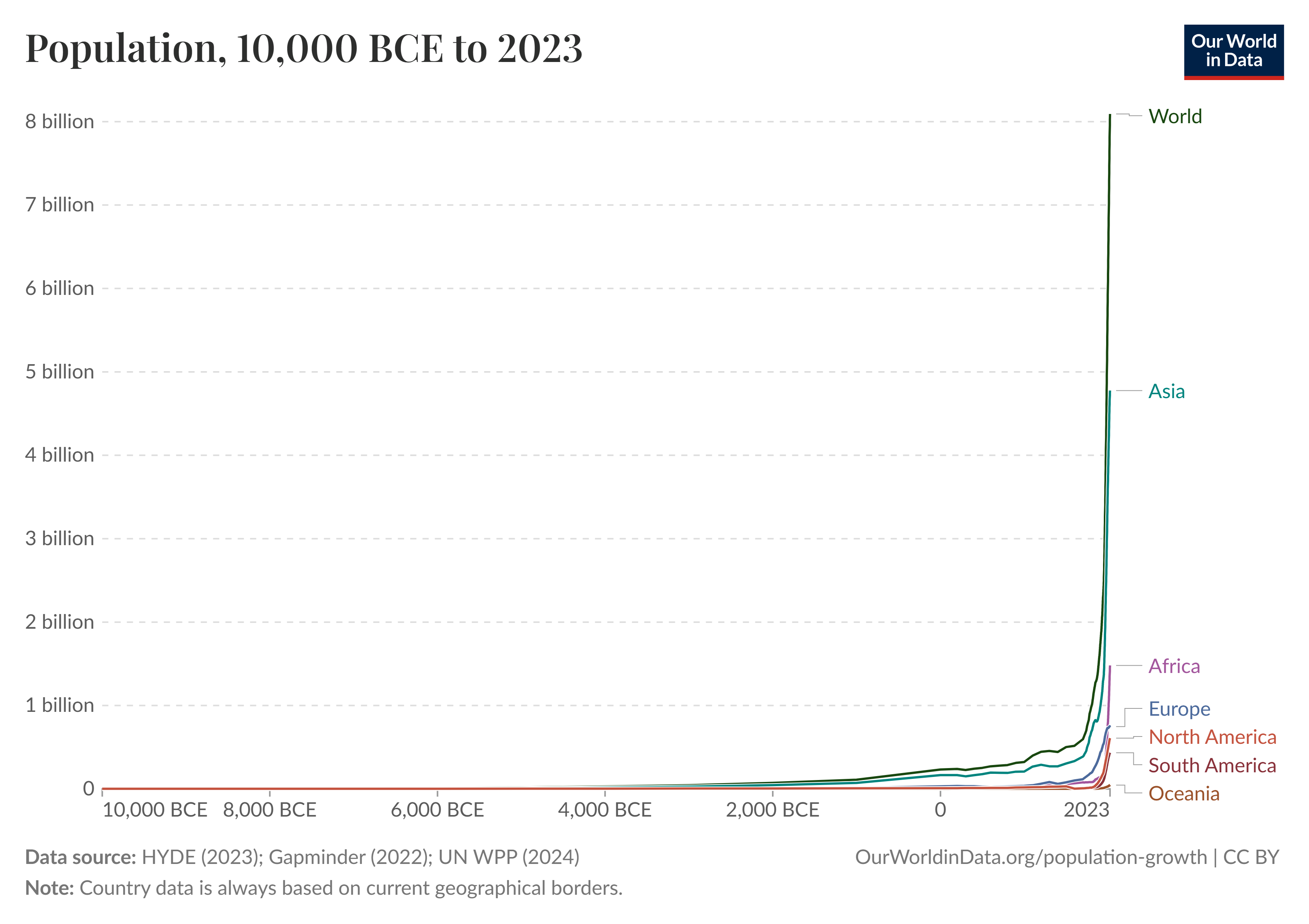
What does it mean to you to see an explosion like this?
Around that 0 in the graph above, the switch from BCE to CE, is where half of humans were born before The Zero and half of humans were born after (source). It took around 10,000 years to get to our median because in the past 2,000 years we’ve exploded onto the scene. More specifically in the past 200 years is when things really got cooking.
But this graph is actually kind of shitty in my mind. If you actually reframe it to the number of humans that saw adulthood then that halfway point at The Zero gets shoved spookily close to the modern age. As a broad generalization, you only have to go back around 150 years to reach a point where every second child died.
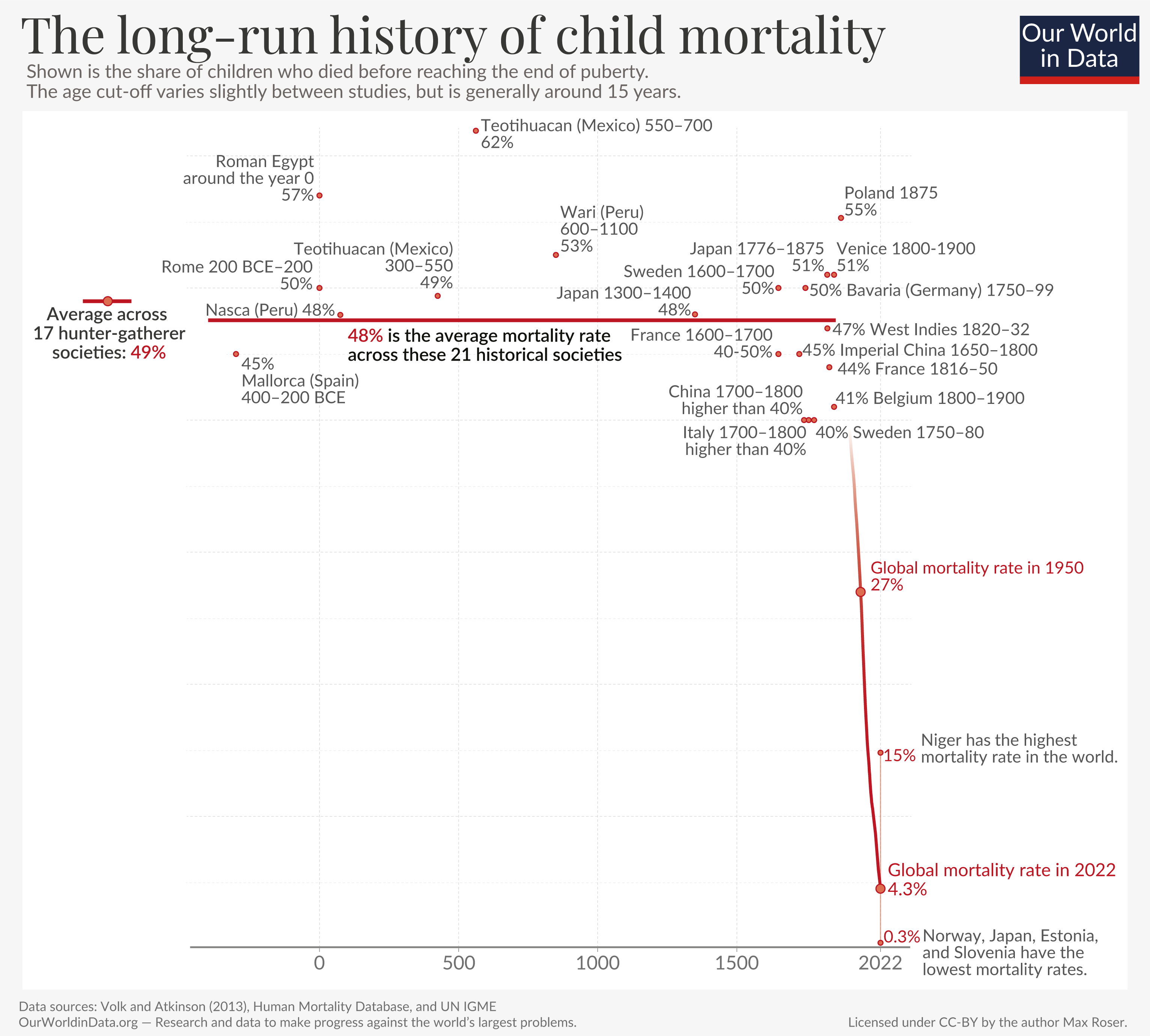
Let’s put that together with broad numbers. If you go back only three hundred years or so you would find yourself at an inflection point in human civilization. At that inflection point the human population was going to begin a headlong rush towards doubling all humans ever born who survive to adulthood.
If you find every human to be a fragment of divinity, then you cannot help but be relentlessly optimistic at the fact there are 8 billion of us and fewer and fewer of us have to watch our children die. For all our many faults we are in a place that is quantifiably better than ever before.
Say it again: There is not a better point in human history to be alive than right now.
But say also: We have so much further to go.
The world is awful. The world is much better. The world can be much better.
Humanity, fuck yeah.
Unnatural World
The problem is that humans in the developed world are incredibly ill-prepared for this world we find ourselves in. Biologically we are not wired to live in a world with running water, ready shelter, climate control, artificial light, abundant calories, and the miracle of modern medicine. We are adjusted to watching half our children die. We are built to fight for survival. We don’t know how to handle this world of relative ease.
I like to tell Squirt — we broke evolution long ago. We are animals evolved into a world that is red in tooth and claw. We are animals who have built a world that doesn’t work that way anymore. We are both the caveman and the astronaut. The caveman is the one ready to live in the natural world, wired for survival and propagation and not much else. But the astronaut is the one that can thrive in the unnatural world we have created.
It is the quest of a lifetime to be this astronaut.
The World We Built
There is a tension here. For over 10,000 years to be satisfied was to fall behind and fail. Nature ate the animal that let itself be satisfied. But we now live in an unnatural world where we broke evolution and created abundance. We built a world where we could finally be satisfied. But we aren’t built to be satisfied. So instead everything feels off. We feel like we are missing something. And because we are animals, we seek and hunger for whatever is missing. The world we built offers those missing somethings up over and over again too.
Food. Money. Sex. Alcohol. Social Media. Games. Screens. Drugs. Politics.
It is the quest of a lifetime to fill a bottomless void.
The Dose
Finally, I’ve arrived at my point. The thing I struggle to explain to Squirt. It is not wrong to temporarily fill this void, but it is wrong to make it an obsession or an addiction. It is not wrong to do things you enjoy, but it is wrong to lose yourself in the enjoyment. It is not wrong to drink a little poison, but it is wrong to drink so much poison you destroy yourself or others. It is wrong to give in to excess.
The dose makes the poison.
We’ve built a world that takes advantage of the void we carry around inside us. We’ve built a world with endless options to fill the void. Some of them destroy you the first time you try them, others destroy you slowly, but most only destroy you if you abuse them. So I will occasionally have my drink of whiskey at dinner but I will always be wary of the tension. And I will do the same for food and games and all the other things the world offers up to fill the void.
It is the quest of a lifetime to balance these things.
Squirt Says…
I find it interesting how the population has more than quadrupled in size in just the last 200 years. We've been around for 100,000 years. What changed? Was it some new technology? How could we have possibly go from less than a billion to 8 billion that quickly. Also, how dare you make fun of me for having an understandable distaste of the poison that crawls in your bloodstream.
Dad Responds…
The other thing you might find interesting is that we are rapidly approaching the peak population on the planet if trends continue. According to the United Nations World Population Prospects 2024, the global population is expected to peak at approximately 10.3 billion in 2084, before declining slightly to around 10.2 billion by the end of the century.
Lots of this is just logistic equations as life expectancy grows. Simple things like clean water, washing hands and understanding how infections work are the primary drivers. So technologies but not necessarily something we think of as technology anymore, it’s just part of civilization — at least in developed nations.