Revolution
I love the concept of epochs. One moment in time when everything changes. For me the idea is closely associated with the idea of a revolution where something rapidly transforms in a fundamental way. In Sapiens, Yuval Noah Harari breaks human history down into three revolutions: Cognitive, Agricultural, and Scientific. I like to take it a step further and break human civilization down a little bit more. I did so when I wrote Scarcity is the Lens but I’m going to crib it a bit here:
Cognitive Revolution — invention of language and semantics for spreading knowledge and connection
Agriculture Revolution — using knowledge, we started solving for food so we could have more brains to generate more knowledge
Scientific Revolution — invention of systematic gathering and utilization of knowledge
Industrial Revolution — using knowledge to begin solving for human labor weaknesses, the first true steps to removing scarcity
Internet Revolution — explosion of knowledge and connection available to humans
AI Revolution — using expanded knowledge and connection to begin solving for human knowledge weaknesses, another large step to removing scarcity
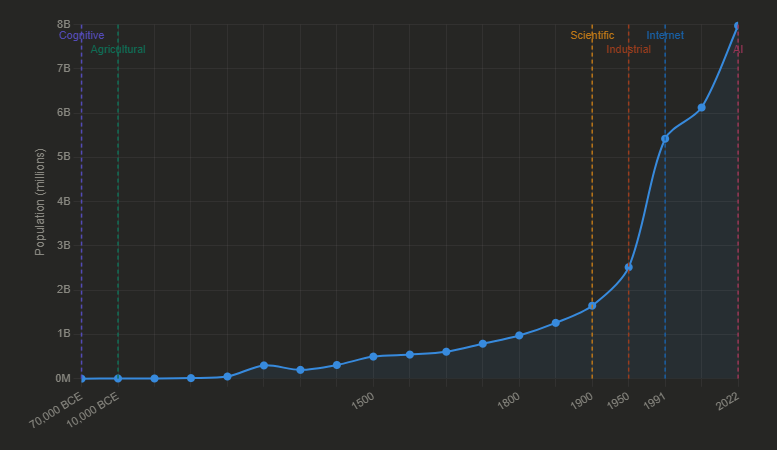
In the broadest strokes, this is humanity. These are our epochs. These are the turning points. Revolutions that fundamentally transform our world. And it is accelerating, as you can see from the hockey stick shape that traces an exponential explosion of human population.
The Thing You Want To Argue About
It’s the AI thing, right? Is this just another piece about how AI is going to change the world? One more tech bro who wants to frame AI as a revolution when it’s really just horrible? It’s a bubble. It’s bad for the environment. The water usage. The energy. The taxpayers that have to foot the bill for the utility costs. The economic shake-ups.
Fuck it. For the purposes of this piece let’s just throw out my injection of the AI Revolution. The last big revolution in human civilization was the Internet Revolution, alrighty? Cool?
Great! Glad we could agree on that.
It Ain’t Worth It…Usually
But, you know, now that we’ve agreed on me being wrong, let’s talk. Let’s talk about an unwillingness to go down some roads. Some arguments just aren’t fucking worth it. Sometimes the juice ain’t worth the squeeze.
I could never write a single word ever again about AI and absolutely nothing would change about the march of human civilization. I could write a library worth of takes on AI and…wait for it…nothing would change about the march of human civilization. The stark truth is that I’m almost certainly powerless to alter the march of human civilization.
And you probably are too.
I think grasping that perspective is important, because I think it’s important to recognize reality, which was the first step of the framework I mentioned in Powerless.
Here’s an interesting image that Claude generated for me. I asked it if every human who ever lived was a drop of milk how big would the container be to hold all of us? The answer is 177 shipping containers stacked together or a six-story office building - not actually that much needed to contain 117 billion “humans as milk drops.”
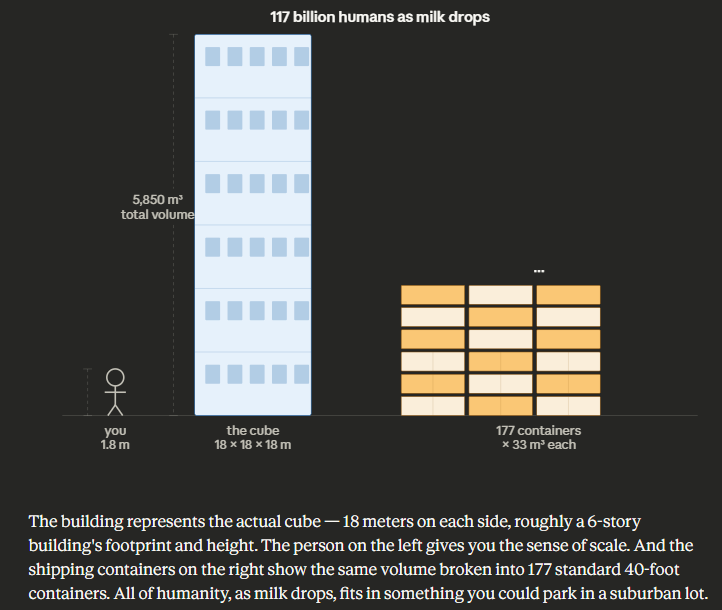
It’s an interesting metaphor of powerlessness to imagine yourself as a drop of ink that drips into a six-story building filled with milk. Will anything actually change? Of course not.
But the world is filled with ink drops that did shift it all. Norman Borlaug. Gutenberg. Newton. Jesus. Marx. Darwin. Alexander. Muhammad. Hitler. Mao. George Washington.
Dad Note: I actually fell down a rabbit hole here arguing with Claude about their top twenty list vs. my list. It didn’t have Borlaug or Washington, and while it immediately put Borlaug in the top ten when I brought him up, it then equivocated on Washington and maintains that the American Revolution succeeds without him. Another thing to sit with — there isn’t a female on either of our lists. As Claude stated: “…the list reflects history more than capability. For most of human civilization, women were systematically excluded from the positions in which civilizational-scale impact was possible.”
So were these men heroes and villains of human civilization? Were they the “Great Men” I argued about in my review of Oppenheimer? I am ambivalent. But whether it was them being special or the time being right…the next Norman Borlaug is out there. The next Norman Borlaug could very well be Squirt. But the odds are pretty strongly against it and we should recognize that.
Choice
As is my custom, I’ve wandered around quite a bit. What does any of this have to do with “a refusal to be miserable?” Where are we going with this?
We are, each of us, a drop of milk in a six-story building. Just one star in the galaxy. I think in the end there are only two ways to respond to this realization…
Choose to be miserable or choose not to be. But you are always making the choice.
Every story, every life, every day we have a choice. Living life can be reduced down to making choices so much that I began a tag page to capture all the endless variations. Every story that has a climax has, at its heart, a choice. An inflection point. Turn left or turn right? Take the risk or not? Fight or capitulate? Climb the mountain or stay in the valley?
We cannot control the world. We mostly cannot change the world. We can always control ourselves. We can always change ourselves.
I refuse to be miserable.
What about you?
Squirt Says…
I find it interesting that all of humanity could fit in those 177 shipping containers represented as milk drops, but I don't feel that entirely represents it. [Some] have more impact then others by luck or hard work. Either way, I think it would be more accurate to have each drop size to be depending on their impact on humanity just to show how small of an impact you have on the world.
Dad Responds…
It’s true the metaphor breaks down a bit. It makes me think of a meme that shows up throughout civilization: “We all die twice; the first time is when we cease to be — the second, when we are forgotten.”