On Thursday there were some Supreme Court opinions that dropped. Tis the season. I was watching the SCOTUSblog chat when they were dropping because I’m a nerd like that. Most days the Supreme Court is actually my favorite branch of the American government. Mind you, it used to be Congress before I realized that it doesn’t have to worry about doing its job. Congress doesn’t bother with its job because the American electorate is largely unconcerned with doing ours and holding them to account.
SCOTUS, though? SCOTUS does its fucking job. This is illegal. This is legal. You can’t do this. You can do this. Here’s how we decided so you know for next time, so don’t come talk to us again.
They clear the Fuzzy. Sometimes.
Categories
There is an interesting linguistic subtlety between the words “absolute” and “categorical” when you’re talking about the law. The AI and I are struggling to find easy ways to exhibit this via links but we landed on one from Cornell about the categorical approach to restricting speech. The gist of it is this: not all speech in America is free. You have to categorize it first because some categories are, indeed, not allowed. To wit: obscenity, child pornography, defamation, fraud, incitement, fighting words, true threats, and speech integral to criminal conduct. This is contrasted with “absolute” where, literally, there are no restrictions. Absolute free speech would allow child pornography. Categorical free speech does not.
I deliberately chose the most odious example because pretty much everyone can get on board with categorical restrictions. Unless of course you’re incredibly rich and powerful in which case that’s not true apparently. Whatever happened to those Epstein Files anyways? Hmm.
Let’s move on from that one, though, before I devolve into a pointless ragefest I won’t be able to publish. Let’s talk instead about obscenity. “Normal” hardcore pornography if you will. Have you ever heard the phrase “I’ll know it when I see it?” when talking about pornography? Did you know it came from a Supreme Court Justice?
Talk about fucking Fuzzy.
I think a big reason that line is famous is because it’s a flagrant failure of a Supreme Court Justice. It’s abdicating responsibility to define a bright line or at the very least a balancing test. But there are lawyers who, surprisingly, would argue with that. Fucking lawyers will argue about anything. They’re all professional nerds, whereas I’m just an amateur.
But they argue for the same reasons I argue. To find some clarity. To establish a decision-making framework. To find out who is correct. Like so much else in life, it all comes down to choosing. That is the job of the Supreme Court - to form an opinion on who the United States of America as a nation says is “right.” At least until the next time a court case comes up with a different set of members on the Supreme Court and changes its mind.
Transition
I apologize for the long journey into legal theory, but if you made it this far, I promise it’s going to be less nerdy from this point forward. Well, less “legal nerdy” I guess.
Anyways.
I have a gradient saved to my computer with no words on it. I use it for some of my posts. Earlier I linked to my choice tag and you will see this gradient show up a fair bit only with words added to the poles in many pieces. The gradient is the visual personification of one of my favorite mental models for life: the continuum. The gradual transition from one state to the other. Where does “red” stop and “blue” start in this image?

Part of making a choice is finding the turning point. Collapsing the wave function. Choosing when the transition actually happened. Deciding where red stopped and blue began. But this model shows up everywhere. You can talk about how much choice a person has vs. how much they are a victim of circumstance. How much perfection over pragmatism you are comfortable with. How much caveman over astronaut. In fact, almost everything on my choice tag is a question about putting yourself somewhere on a continuum of some choice. Choosing where you want the other color to begin.
I like ambivalence because it recognizes that there are two poles, but I think frequently a healthy existence is making a choice somewhere in the middle. It is almost never the “bright line” that courts are always attempting to find. Instead, it is The Fuzzy. The transition. That’s probably not very clear, I know, but hey look at the title of this piece you know?
So consider the following gradients of age. On the left is the “young” pole, and opposite it is the “old” pole. But the transition is in an entirely different spot depending on the age of the chooser. A five year old has a very different idea of when someone has become “old” than someone who is sixty-five or twenty years old.
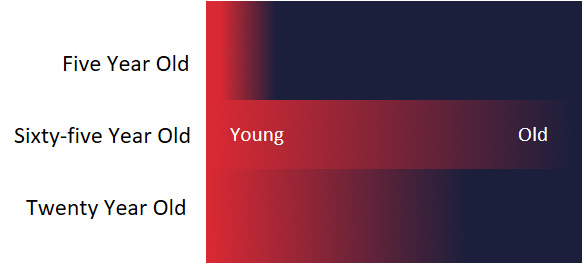
Transition - Death
What about death? Do you know when someone is considered dead at the hospital? It’s not when they’ve stopped breathing. It’s not when their heart has stopped. It’s not even based on their brain activity. The definition of dead in a hospital is only when a doctor declares someone has a time of death. You can come back from a stopped heart. You can start breathing again. Some bodies can live for years without a functioning brain. It is a Fuzzy transition and you’re not dead until someone with authority calls it. In fact, in the United States, every single person must be pronounced dead by someone who is authorized.

Largely irrelevant to most people most of the time, right? I know I’m alive. I know my grandparents are long dead. I know hospitals fucking suck in large part because it makes me think about those types of transitions. But this is the most important question when someone is on death’s door. The hospital doesn’t ever stop trying to save you until someone calls time of death. Until the transition happens.
Transition - Life
What about life? Do you know when someone’s life has begun? When a bundle of rapidly multiplying cells becomes a child? This is the fundamental question at the heart of abortion legislation for me. Consider this image, which is a reversal of the death transition with different words. When you declare someone dead they cease to be a person and become a bundle of cells.

The pro-Life argument is that “life begins at conception.” That is, as soon as an egg is fertilized it becomes a child. It’s a reductive argument, and I think it falls apart when placed into a hypothetical. Consider a nurse carrying a hundred vials filled with such fertilized cells who drops them and they smash. This nurse is not a mass murderer. Indeed, if that same nurse had to make a hypothetical choice in a burning building between saving a thousand of such vials and saving a single one month old newborn they would invariably choose the newborn. Beyond the rhetoric and the politicization almost everyone understands that there’s a transition at some point after fertilization when that bundle of cells becomes a child.
Absolutes
“Only a Sith deals in absolutes.”
~ Obi-Wan Kenobi
What I like about this quote is the absurdity. Obi-Wan is making an absolute statement and is part of a dogmatic institution that deals in absolutes all the fucking time and that’s at least part of the reason for Anakin’s fall. It’s just ridiculous. It is also such an amazingly human thing to say.
Humans are so desperate to find clear and absolute answers we will descend deep into hypocrisy. We will retreat into insouciance. We reduce incredibly complex and nuanced topics into single sentence sound bites. Everything becomes red or blue on my all-encompassing gradient.
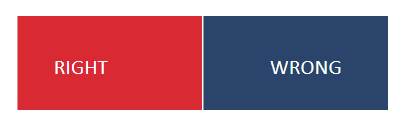
There we go. A nice bright line between “right” and “wrong.” You’re either with us or you’re against us. You are my friend or you are my enemy. You are good or you are evil. There is no Fuzziness anywhere. Clean and simple. Absolute.
Fucking absurd.
Well, absurd sometimes.
You do, eventually, have to find the line. There must be an inflection point. You have to declare the patient dead. You have to declare the bundle of cells a life. You need to recognize when you’re too fucking old to be trying that ill-advised acrobatic.
You have to choose.
But recognize the Fuzzy.
The Problem
The first step to solving a problem is recognizing that there is one, but I do not see the Fuzzy as a problem. In fact, I see it as an intrinsic part of the world. Mathematics agrees and has an entire field called Fuzzy mathematics. The injection of randomness in computing is an attempt to bring some Fuzziness to the world. It’s so difficult that Cloudflare resorted to a wall of lava lamps. The reason it is so hard is that we are constantly trying to create a world that is binary and deterministic. We want a world that makes sense. We want a world with bright lines. We want a world without the Fuzzy.
We are the problem.
We must grow more comfortable with the Fuzzy. Comfortable with not knowing exactly where the line is. Comfortable with others deciding the line is a little bit more in one direction than where we might draw it. Humans are inclined to turn everything into a false binary because we want it to cleanly fit into our decision-making.
We need to be comfortable saying we do not know.
We need to be comfortable embracing complexity.
We need to be comfortable with not deciding.
Squirt Says…
I think partly the reason we don't like the Fuzzy is because the Fuzzy is not a fact. It can have multiple meanings and we as humans want truth, and facts are simply put an absolute. We, as humans, don't like the Fuzzy, we like the simple. The “I don't have to think about it.” The transition is something humans don't like.
Dad Responds…
Well put. I like the focus on “factfulness” as the thing humans want. It’s interesting because, as a general rule, humans are frequently not truly interested in facts but perhaps just the appearance of facts. It’s a bit of a paradox.