


Scarcity
Civilization is a zero-sum game. Wikipedia states it is a “mathematical representation…that involves two competing entities, where the result is an advantage for one side and an equivalent loss for the other….”
To say it a different way — if one thing is “winning” then something else is “losing.” There is not enough to go around. This is contrasted with a non-zero-sum game which, coincidentally, is what I was writing about just a couple days ago with The Prisoner’s Dilemma. This dichotomy is incredibly important to me when it comes to analyzing events and motivations. A day or two after Maduro was kidnapped from Venezuela, I wrote about exactly this in Scarcity is the Lens. My point then was to focus on how civilization can take three steps forward and then two steps back but there is overall forward progress. Today I want to focus more on the fact that choices can mean a march forward on one thing while there is a price paid by other things.
In other words, we’re going to talk a bit about what a budget is.
With President Trump starting a war with Iran, these types of comparisons are coming up in my information stream over and over again. I went and found something that’s over a decade old just as an illustration rather than using a current one but the sentiment is the same for all of them. And let me preface this with — there are a bunch of things that are misleading about this graph. Like all the criticisms it is factually correct while being misleading.
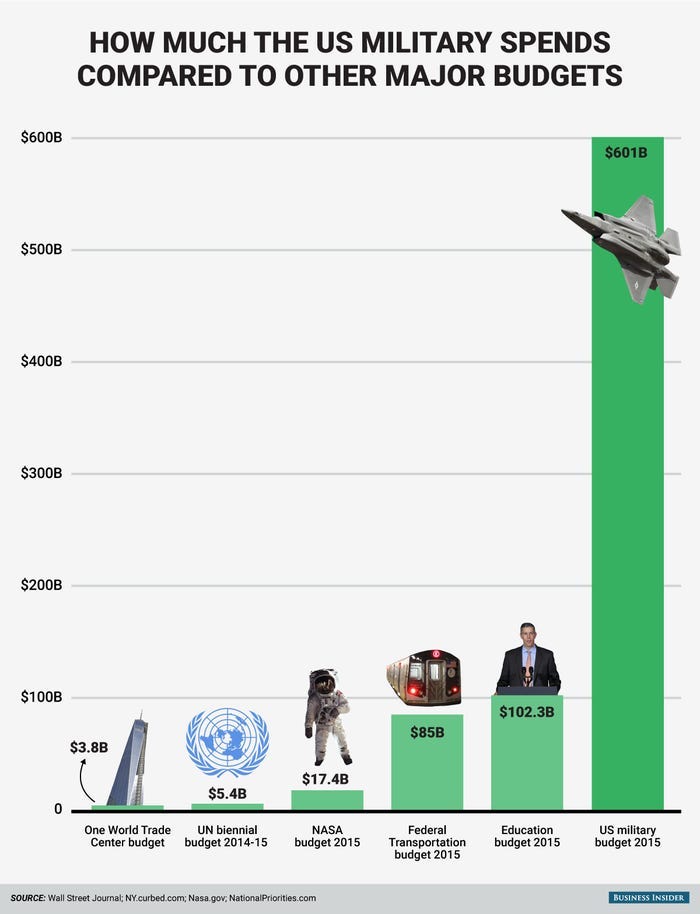
Like I said, there are a bunch of things wrong with this — most notably that state budgets should factor into a bunch of these things. Take education, a quick LLM response because I was lazy on the research:
In South Carolina, public K–12 schools are funded roughly 15% by the federal government, 45% by the state, and 40% by local sources, meaning about three-quarters of school funding comes from within the state rather than Washington.
Barely any of the money that goes to educating Squirt actually comes from the federal budget, so in some ways this image is just an example of lying with statistics. But in another way it is absolutely telling the truth about the zero-sum game that is the United States budget: Every dollar spent on defense is a dollar not spent on something else.
Sacrifice
This is identical to my personal budget. If I pump too much money into my saltwater aquarium hobby then I cannot afford to pay my mortgage. I cannot put (now very expensive) gas in my car. Keep the electricity running. Food on the table. In a scarce economy you must prioritize things, and if you prioritize the wrong things then bad shit happens. Everyone makes their own prioritizations and they are all subject to criticism and judgement. Buying too big a house, taking too lavish a vacation, spoiling their kid with electronics, or just pouring money out when you go to a once-a-year coral expo and then finding out that you bought coral and you don’t even have a place to put the coral in the aquarium so you seriously consider just buying a bigger aquarium and really it just makes sense because then you’d have lots of room, right?
Ahem. Anyways.
A dollar spent on one thing is one less dollar I have for something else. A government’s role is the same. They spend a dollar on one thing and that’s one less to be spent somewhere else. A government’s role is to pick priorities. And every foreign policy decision is a choice to either spend something on a foreign thing or to ignore it.
With Trump’s destruction of the USAID program an estimated half a million children around the world have died according to one dashboard I found today. A quarter of a million adults too. 88 deaths an hour. I can’t speak to the accuracy of the numbers but they pass a sniff test to me. USAID was not a priority for the administration. Better instead, they would say, to keep that money in our own country.
The Russian invasion of Ukraine has just passed four years. There are now over 15,000 civilians estimated to have died along with over 100,000 soldiers. The Russian deaths are about triple that, surpassing 300,000 soldiers. To shift some lines on a map. America can shift those numbers by spending more money to help Ukraine. We could make it much more painful for Russia by sending more weapons and pouring even more money into the region. But every dollar we spend on Ukraine, well, that’s one less dollar spent on our children or our transportation or building a rocket to go to the moon.
There are always tradeoffs and something will be sacrificed. Whether that’s dead children halfway around the world, fewer dead Ukrainians, or a dead Iranian leader.
Pax Americana
Just because you do not take an interest in politics doesn’t mean politics won’t take an interest in you.
~ Pericles
Every foreign policy decision, every choice made by elected leadership in America, impacts me. Every dollar spent on a missile was a dollar lost to something else. So starting a war with Iran is meaningful to pretty much everyone who reads this. Dead Americans. Climbing cost of oil. A war touches us all.
I am not someone who immediately speaks out against war. I am generally a fan of Pax Americana and one of my favorite phrases from the Wikipedia article was “Pax Americana was based on the military preponderance beyond challenge by any combination of rival powers and projection of power throughout the world's commons – neutral sea, air and space.”
In other words — there was peace because we had a much much bigger stick and had signaled a willingness to use it. And I fucking love peace. If the only way we can get it is by having a really big stick then, fair enough, let’s buy another jet and buy it in the name of peace. As pretzel-brained as it sounds, you may very well achieve peace by going to war. There is an argument to be made that going to war with Iran could lead to more peace than that country has had in the past decades. There is an argument to be made that peace there is a peace that will be good for America.
I don’t think we, as Americans, really understand at all what living under the thumb of a theocratic regime is like. I’m pretty certain on that since we are not participating in violent uprisings and having thousands of folks murdered in the streets while they fight back against their government. So overthrowing the regime is a net good for civilization, I think. And it has a possibility of leading to peace.
But is it worth what we will pay?
No Answers
I don’t have any answers. As usual, I have an incredibly high level of uncertainty about what’s going down on the other side of the world. But I understand why America has grown the power it has, I understand that decisions have to be made about when to use it, and I understand that the administration will make decisions on priorities I won’t agree with. I know that going to war will cost Americans quite a bit. I know it’s also an opportunity for Iranians after decades of very bad things.
I am most wary of those who are certain this is a good thing or a bad thing, and I am most wary of those who want to hide from the prices being paid.
Squirt Says…
I’m not sure why we need such a big stick. We spend so much on military and weapons and yet we don't need and mostly don't use it. We use it as a threat. Yet we don't need it. We have alliances if China suddenly attacks us. We don't fight it all alone. We could spend it on education and advancements into technology.
Dad Responds…
We might not fight China alone. I’m not sure depending on other nation states on the other side of oceans is the right way to defend ourselves. But it’s undeniable we could do more to improve our country with education and technology if we spent less. It’s a delicate balance.
Final Thought
Maybe my favorite random AI generated image for a Substack post yet. The more you look the more you realize it’s kinda close but not really. A fantastic example of how surface-level the image generation can be. All I wanted was a Sankey diagram but, alas, it could not get there so I gave up and went for a spreadsheet.